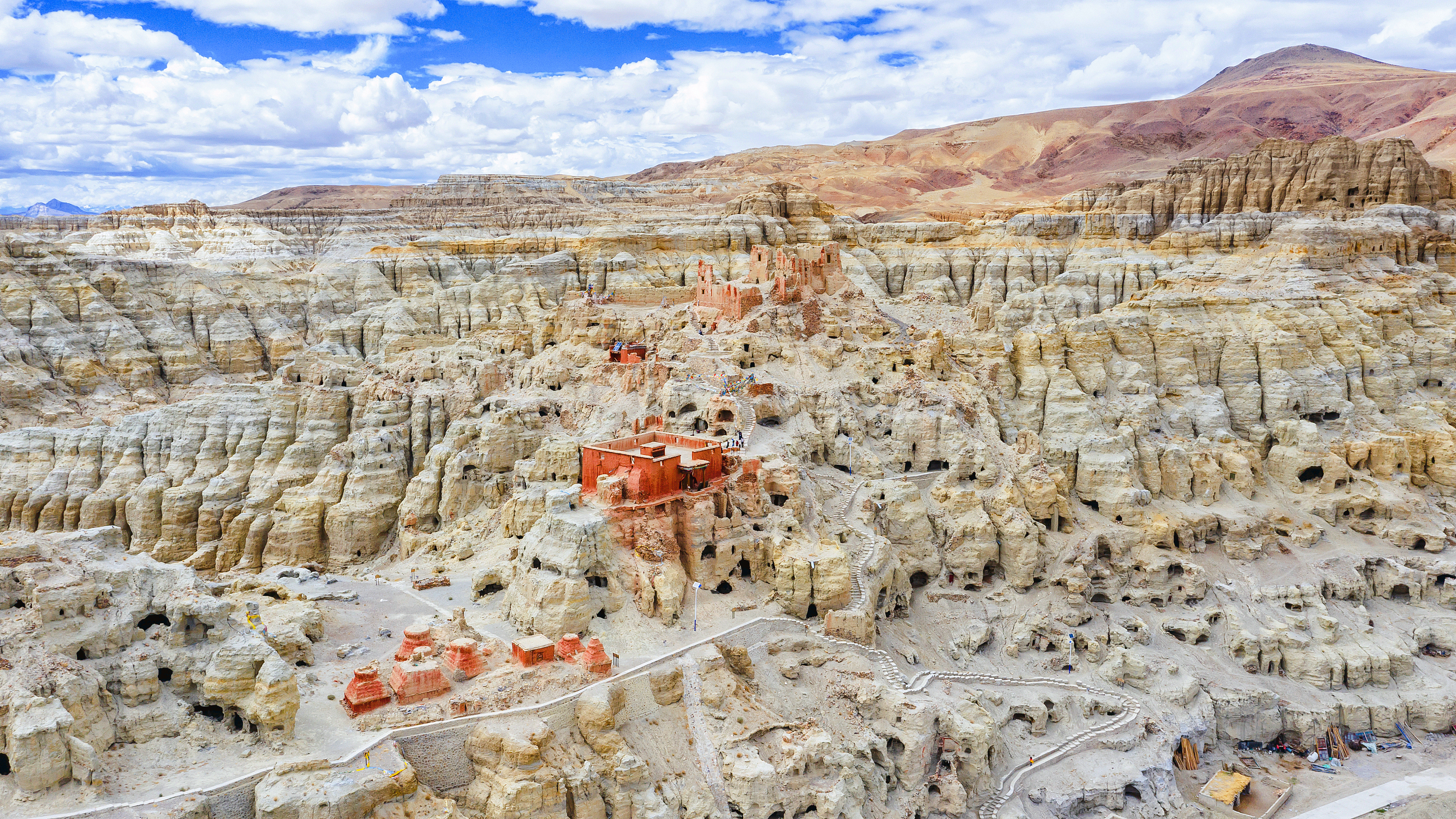
The Dongga site is a grotto discovered only in recent years. After preliminary research by relevant experts, it is one of the eight major monasteries built during the Rinchen Sangbu period of the Guge Dynasty. Dongga Grottoes are scattered on the cliff to the north of Dongga Village, and you can see dense caves on the mountain on the road. There are nearly 200 existing caves, stretching for 2 kilometers, like a beehive. Among them, several caves with exquisite murals are concentrated on a “U”-shaped cliff in the east. The Dongga Caves and Piyang Caves excavated by archaeologists are located on the rocky cliffs near Dongga Village and the adjacent Piyang Village. This is the largest Buddhist cave site discovered in Tibet so far. The Dongga murals concentrated in the three caves on the mountainside are well preserved. Its formation and age are not recorded in many Tibetan historical, religious and cultural archives, and it is a cultural mystery that has yet to be solved. But one thing is certain, the cave paintings have a history of nearly a thousand years, and the archaeological and research values are quite high. The frescoes in the grottoes have a long history and are rich in content. There are also some foreign characters, patterns and shapes in the paintings. The frescoes are painted with special mineral pigments, which will last forever without fading. The main themes of the murals are Buddha statues, Bodhisattva statues, Buddhist stories, teaching diagrams, etc., as well as various decorative patterns and esoteric mandala. There are many kinds of goddess patterns, with vivid shapes and rich changes.
Piyang Dongga Cave Site
作者:
在