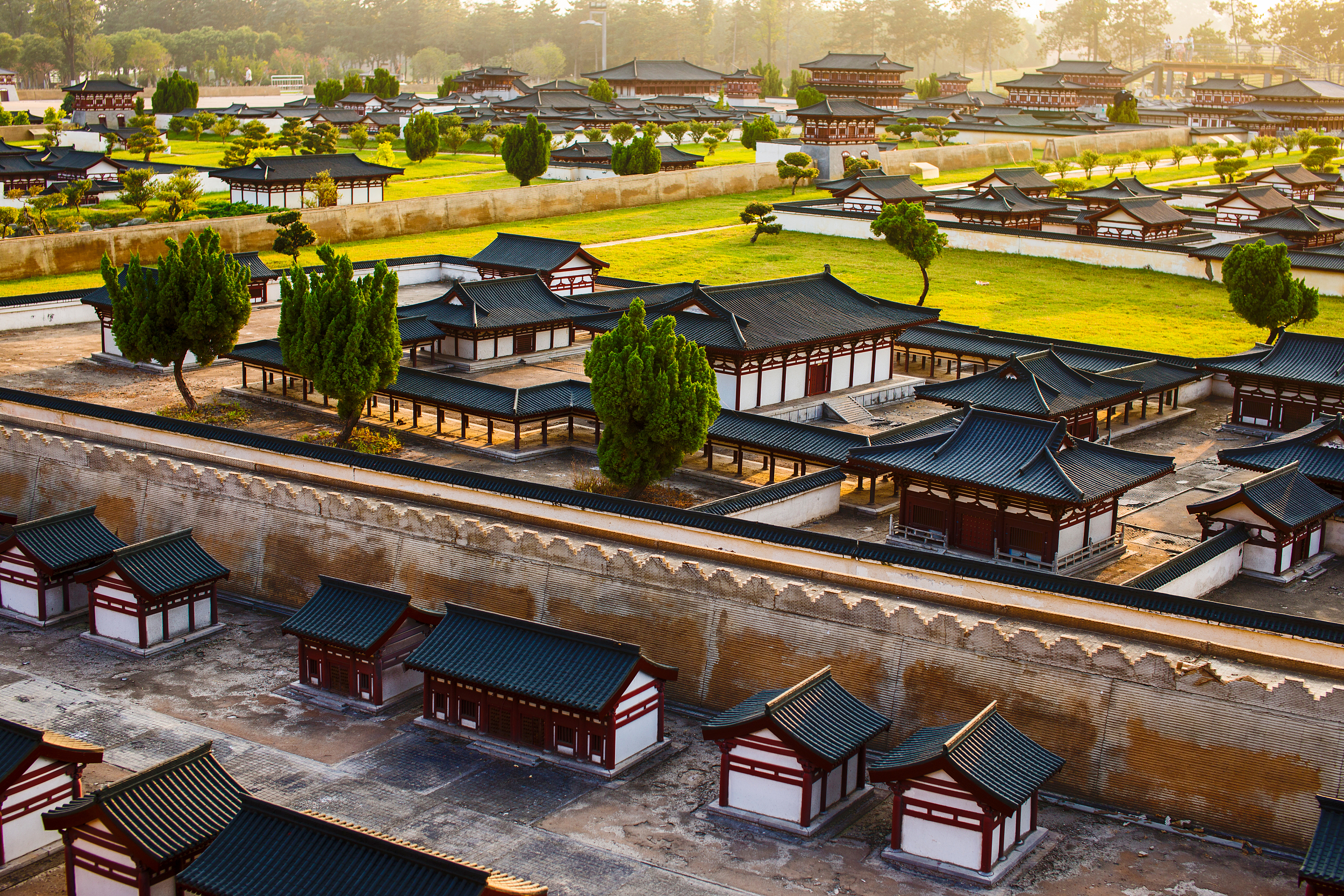
The Daming Palace, the grand imperial court of the Tang Empire, served as the political center and national symbol of the dynasty. As one of the “Three Great Palaces” (Daming Palace, Taiji Palace, and Xingqing Palace) in Chang’an, it was the largest and known as the “Eastern Palace.” From Emperor Gaozong’s reign onward, 17 Tang emperors conducted state affairs here for over 240 years. This magnificent architectural complex stood as one of the world’s most expansive palace compounds during its time.The lines from poet Wang Wei’s “Morning Court at Daming Palace in Response to Jia Sheren” – “The nine heavens’ gates swing open to reveal the palace; envoys from myriad nations bow before the imperial crown” – epitomize the grandeur of Tang Dynasty’s golden age, showcasing the empire’s majestic authority and the solemn magnificence of imperial ceremonies.The Daming Palace was first built in the 8th year of Emperor Taizong’s Zhenguan era (634 AD), covering an area of approx. 3.2 km². The entire palace complex can be divided into two main sections: the outer court for official assemblies and the inner court for residence and entertainment. The outer court centers around the Hanyuan Hall (outer court), Xuanzheng Hall (middle court), and Zichen Hall (inner court), while the inner court features the Taiye Pool along with over 30 auxiliary halls, pavilions, and observatories.The term “Daming” first appeared in the “Daming” chapter of “The Book of Songs: Greater Odes.” According to the “Mao Commentary,” it signifies: “King Wen possessed brilliant virtue, so Heaven again commanded King Wu. As King Wen and King Wu succeeded one another, their brilliant virtue daily grew more vast, hence the name Daming.” Like the name Weiyang Palace, which also originates from “The Book of Songs,” Daming Palace served as a self-motivating symbol inspired by the diligent governance and wisdom of the Zhou kings.The origin of Daming Palace is also associated with a fascinating legend. During its initial construction, an ancient bronze mirror was unearthed at the site. The renowned statesman Wei Zheng recognized it as the “Qin Mirror,” a national treasure once used by Emperor Qin Shi Huang to eliminate political dissidents. Legend claims this mirror could reveal a person’s internal organs with astonishing clarity. More significantly, it could distinguish loyal ministers from treacherous ones and predict the rise and fall of dynasties. After Daming Palace’s completion, the Qin Mirror was hung in the imperial court to ward off evil spirits, giving rise to the idiom “a bright mirror hung high” (symbolizing impartial justice). With this treasure safeguarding the palace, the atmosphere became one of supreme integrity and enlightenment—hence the name “Daming Palace” (Great Illumination Palace).On March 4, 1961, Daming Palace was designated by the State Council of the People’s Republic of China as one of the first batch of National Key Cultural Relics Protection Units. In 2010, Xi’an established Daming Palace National Heritage Park on the original site. On June 22, 2014, the Daming Palace ruins were successfully inscribed on the UNESCO World Heritage List as part of the “Silk Roads: the Routes Network of Chang’an-Tianshan Corridor.” On October 18, 2021, the Daming Palace ruins were selected among the “Top 100 Archaeological Discoveries of the Century.”The Daming Palace of the Tang Dynasty was a magnificent architectural complex in Chang’an city. The park is built on the ruins of Daming Palace, where visitors can see foundation remains of palaces like Hanyuan Hall and admire the restored miniature model of Daming Palace.The attraction has a south gate and an east gate, with the south gate serving as the main entrance where the visitor center is located. Visitors are recommended to enter through the south gate. The heritage park consists of both free and paid sections, with the paid area covering the core attractions including the Danfeng Gate Ruins Museum at Daming Palace National Heritage Park, Hanyuan Hall Ruins, Xuanzheng Hall, Zichen Hall Ruins, and the Daming Palace Ruins Museum.The Daming Palace National Heritage Park – Danfeng Gate served as the main southern entrance to the Daming Palace, facing the 176m-wide Danfeng Gate Avenue. North of the Danfeng Gate lies the central north-south axis of the palace complex, featuring structures like the Hanyuan Hall, Xuanzheng Hall, Zichen Hall, Penglai Hall, Hanliang Hall, and Xuanwu Hall. Most other palace buildings were arranged along this central axis. According to Yonglu historical records, the Daming Palace’s architectural layout progressed from Danfeng Gate to Hanyuan Hall and then to Zichen Hall further north – all three major structures were built atop hills. The front court area occupied the highest point of Longshou Mountain, with the terrain dropping sharply by several meters beyond this section toward the northern slopes.The Hanyuan Hall, Xuanzheng Hall, and Zichen Hall were the three main halls of Daming Palace, with Hanyuan Hall serving as the principal throne hall. Flanking the Xuanzheng Hall were two key government offices – the Secretariat and Chancellery – along with the Hongwen Academy and Hongshi Archives. Parallel to the central axis, two longitudinal streets ran east and west, created by aligned gateways piercing through three transverse palace walls.The northern side of Longshou Hill served as the rear court, featuring low-lying terrain where water from the Longshou Village canal was diverted to form a lake—Taiye Pool. The emperor’s sleeping quarters and auxiliary halls were mostly concentrated on the elevated grounds of Longshou Hill southeast of Taiye Pool, while the areas for handling state affairs and hosting banquets with officials were situated on the high ground southwest of the pool. The expansive, flat northern shore of Taiye Pool accommodated recreational facilities and auxiliary views, such as the Shicui Hall, Horse Racing Tower, and Cockfighting Platform. The Linde Hall, built approx. during the Linde era of Emperor Gaozong of Tang, stood on the elevated land west of Taiye Pool in northern Daming Palace. As previously mentioned, there were also over 30 other detached halls, pavilions, and viewing platforms in the vicinity.At the attraction, visitors can view the foundation ruins of major halls and the palace outlines recreated with light steel structures on these ruins. Inside the Daming Palace National Heritage Museum, you’ll see artifacts unearthed from the site, including royal utensils and vessels. In the northeast corner of the museum, there’s a 1:15 scale miniature model of Daming Palace where you can “walk” along its streets and immerse yourself in the grandeur of Tang Dynasty’s imperial palace.Inside the Danfeng Gate Museum at Daming Palace National Heritage Park near the south gate, the ruins of the gate tower from the original Danfeng Gate of Daming Palace National Heritage Park are preserved. This site represents one of the largest documented city gates in Chinese history.
Daming Palace National Heritage Park
作者:
在