The Qin Shi Huang Terracotta Warriors and Horses Museum is also known as the Terracotta Warriors and Horses, or the Qin Terracotta Warriors and Horses. It is a burial pit of the Qin Shi Huang Mausoleum, and together with the Qin Shi Huang Mausoleum, it forms the Qin Shi Huang Mausoleum Museum.The Terracotta Army of Qin Shi Huang is known as the eighth wonder of the world. The more than 1,000 terracotta warriors unearthed here have different images and vivid expressions. They are a shining pearl in the history of ancient Chinese sculpture art and are hailed as “one of the great discoveries in the history of archaeology in the 20th century.”Historical backgroundQin Shi Huang started to build the mausoleum when he ascended the throne at the age of 13. It took nearly 720,000 people and 38 years to build. The mausoleum was not completed until Qin Shi Huang’s death. It took more than a year for Qin II Hu Hai to complete it.According to legend, Qin Shihuang spent countless manpower, material resources and financial resources to build an underground palace for himself, and the Terracotta Warriors were the guardians of the underground palace.The Terracotta Warriors and Horses of Qin Dynasty are a typical example of using figurines to represent human sacrifice. The reason why the Terracotta Warriors and Horses of Qin Dynasty reached such a high level in terms of scale and realism is not only due to the wisdom of the craftsmen, but also inseparable from the will of the emperor.In March 1974, farmers in Xiyang Village, Lintong District, Shaanxi Province accidentally discovered some fragments of terracotta warriors while digging a well. After more than a year of exploration and trial excavation by archaeologists, it was confirmed that it was a large pit of warriors and horses, which is the world-famous No. 1 Terracotta Warriors and Horses Pit.In April and May 1976, the No. 2 and No. 3 Terracotta Warriors and Horses Pit were discovered on both sides of the No. 1 Terracotta Warriors and Horses Pit. The size, shape and unearthed artifacts of each pit are different. Some scholars believe that the No. 3 pit is the headquarters of the No. 1 and No. 2 Terracotta Warriors and Horses Pit, which was called “military tent” in ancient times.The Qin Shihuang Terracotta Warriors and Horses Museum, built on the site of the Qin Terracotta Warriors and Horses Pits, was officially opened in 1979. The main attractions include the Qin Terracotta Warriors and Horses Pits No. 1, 2 and 3, the Bronze Chariot and Horse Exhibition Hall and related temporary exhibitions.Tour GuideThe museum ticket allows you to visit three terracotta warrior pits including Pit No. 1, the exhibition hall of unearthed cultural relics, the bronze chariot and horse exhibition hall, and the Mausoleum of Qin Shihuang. The terracotta warriors and horses unearthed here can be divided into generals, warriors, charioteers, etc. according to their different costumes, expressions, and hairstyles. Each terracotta warrior has a different face shape, hairstyle, body shape, and expression. The terracotta warriors and horses were originally painted, but due to later burning and soaking, most of them have peeled off and changed color.Pit No. 1The No. 1 Terracotta Warriors and Horses Pit in the Attraction was excavated earlier. The pit is about 230 meters long from east to west and about 62 meters wide from north to south. According to the arrangement density of the unearthed pottery figurines and horses, there are about 6,000 pottery figurines and horses buried in the No. 1 Terracotta Warriors and Horses Pit, as well as a large number of bronze weapons.Pit No. 1 is also the most stunning exhibition hall that has been put together so far. You can see a huge army of terracotta warriors standing in the pit, with various shapes. It is said that there are more than 30 types of beards. If you look closely, every soldier is lifelike, from armor to expression, from weapons to the lines on the palms, all of which are amazing.Pit 2 and Pit 3Pit No. 2 and Pit No. 3 are located on both sides of Pit No. 1. Like Pit No. 1, there are nearly 2,000 pottery figurines and horses of similar size to real people and horses. There are different types of soldiers, such as chariot soldiers, cavalry and infantry, arranged in an orderly manner. Although it is not as shocking as Pit No. 1, it is also worth seeing because each pit has different teams and functions.The terracotta warriors were created based on real life, with delicate artistic techniques. The figurines have different costumes and expressions, with distinct personalities and strong characteristics of the times. The bronze weapons unearthed in the pit include swords, halberds, spears, halberds, halberds, crossbows and a large number of arrowheads. Most of the weapons are still sharp after more than 2,000 years, indicating that the metallurgical technology was already very advanced at that time.
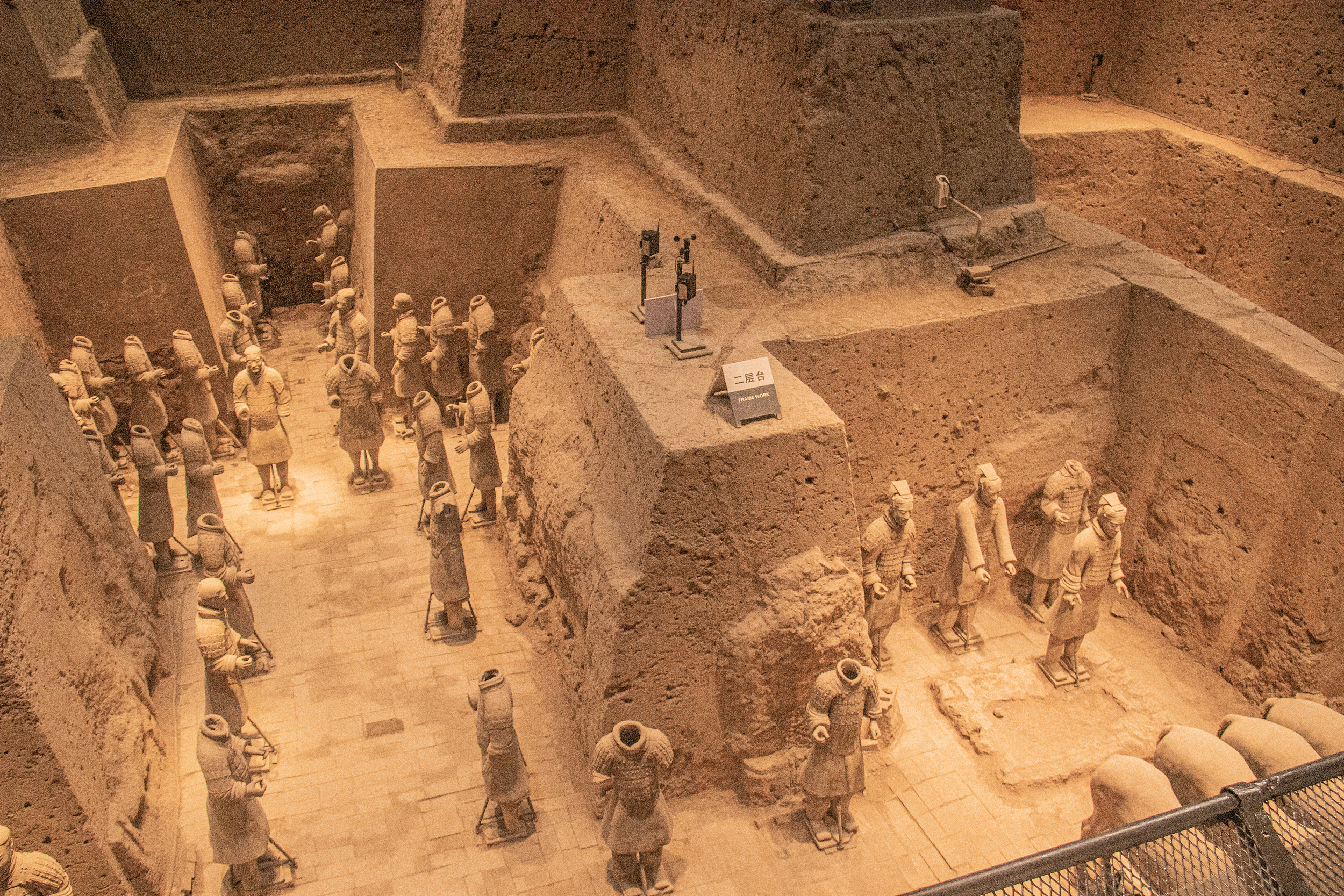
Terra-cotta Warriors Pit No.2
作者:
在