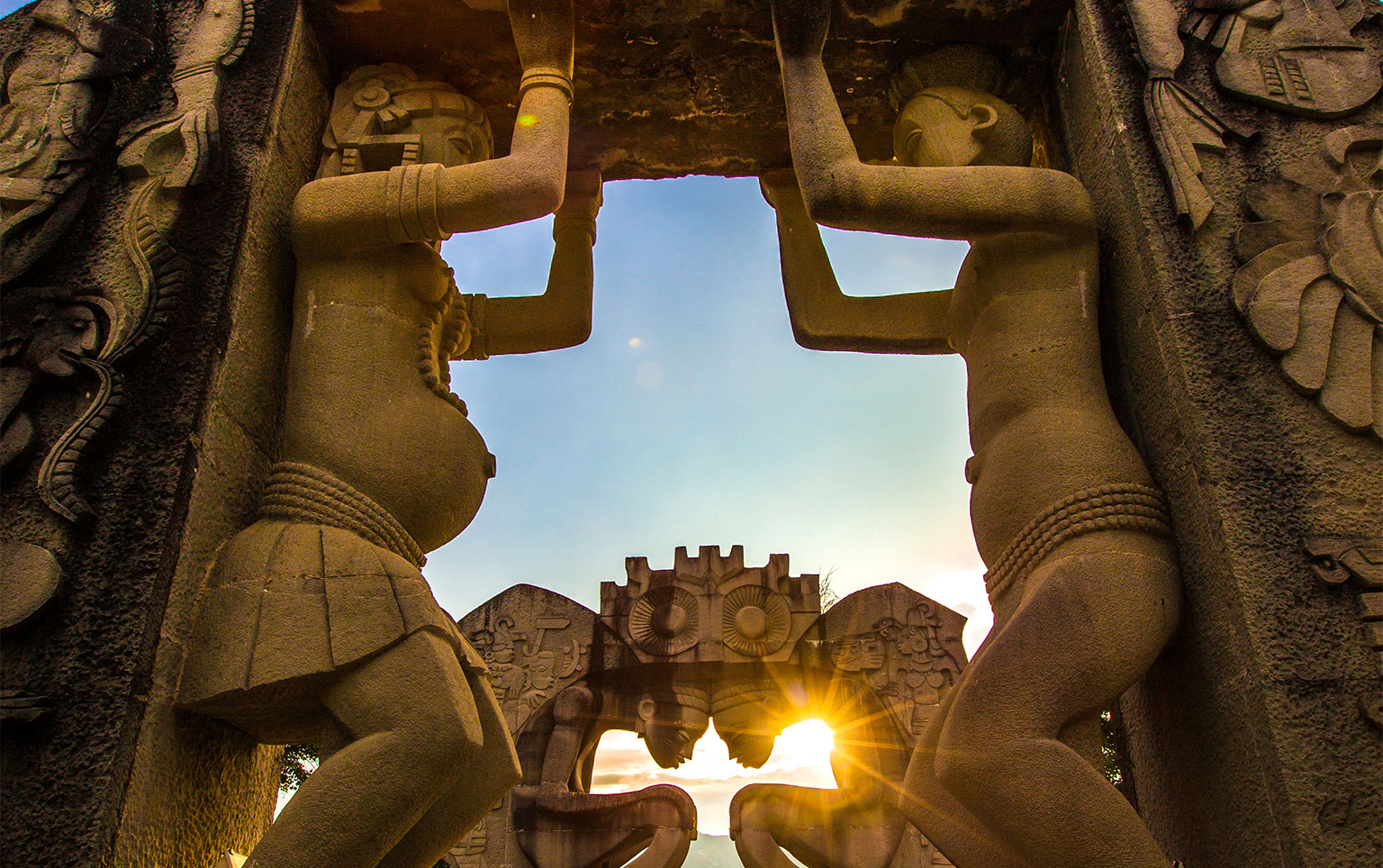
Mojiang Tropic of Cancer Symbol Park is one of the world’s largest and most comprehensive Tropic of Cancer landmarks. This AAAA-rated national attraction integrates astronomy, geography, landscape art, ethnic culture, and tourism into a single geographical landmark. As an important science education base in Yunnan Province, it’s strategically located west of Mojiang County along the eastern side of the Kunming-Bangkok Expressway Mojiang section, serving as a gateway between Kunming and Pu’er/Xishuangbanna. The park’s layout centers around the Tropic of Cancer axis, featuring 15 attractions that use vivid artistic interpretations to enhance visitors’ understanding of this geographical phenomenon, celebrating humanity’s reverence for nature, sunlight, and life. At the 23.5°N latitude, a golden ratio point on Earth’s axis, Mojiang Tropic of Cancer Symbol Park uniquely showcases the mysterious “twin phenomenon” resulting from the combined effects of the Tropic of Cancer’s magnetic field and the miraculous twin wells. Every summer solstice, when the sun shines directly on the Tropic of Cancer, the Hani people hold grand celebration activities with singing and dancing, praying for the sun’s light and warmth to ensure a bountiful harvest and thriving livestock in the coming year. On this day, visitors can witness the astronomical wonder of “no shadow at noon” at Mojiang Tropic of Cancer Symbol Park, which has poetically earned it the nameThe place where the sun turns around. Welcome to Mojiang Tropic of Cancer Symbol Park! Experience the unique solstice culture, savor authentic Hani cuisine, and uncover the mystery of twins here. Popular attractions Magic Carpet Ride The spatial design follows the natural slope of the terrain, seamlessly blending with the surrounding environment like two soaring dragons ascending to the sky. For visitors’ spatial experience, they can board the magic carpet ride for effortless transportation. As the flying carpet ascends at a steady pace, it amplifies the comfort and enjoyment of sightseeing. Along the journey, mysterious stone pillars and statues peek through the jungle foliage, allowing visitors to immerse themselves in breathtaking scenery without taking a single step. Moon Plaza Echoing the Sun Square, this area features a lunar phase diagram and a crater map. The lunar phase diagram meticulously displays the moon’s appearance as seen from Earth each day throughout a month, while the crater map reveals the distribution of lunar craters observed through the “First Telescope of Southern Yunnan.” With its ingenious layout and rich content, the square masterfully blends astronomical knowledge with architectural design. Cultural Stone Steps From a distance, the tiered steps symbolize the Hani people’s rice terraces, embodying their diligence and wisdom. Nestled within these “terraces” are mascots, iconic architectural sculptures, and brief profiles of 19 countries and regions along the Mojiang Tropic of Cancer Symbol Park. Among these 19 nations, most are dominated by oceans or deserts—only Mojiang in China stands out as a rare “oasis.” Twin Stars Plaza The central sculpture depicts a young Hani couple – the woman with a visibly pregnant belly. With bent knees and offerings in hand, they’re praying to the heavens for the safe delivery of their twins. The land shapes its people. In Mojiang, the consistent consumption of “twin water” has become one of the key factors contributing to the high twin birth rate in the region.Twin Stars PlazaThe Yin-Yang wells are located where the Mojiang Tropic of Cancer Symbol Park passes between them. Couples hoping for twins should drink from the Yin-Yang waters, sleep in the twin bed, and can also fasten a love lock here. Mojiang Planetarium The UFO-shaped planetarium at the Mojiang Tropic of Cancer Symbol Park is currently the largest and most comprehensive science museum dedicated to Tropic of Cancer culture. It showcases the fascinating civilizations, legends, and phenomena along the Tropic of Cancer through interactive high-tech displays featuring sound, light, and electrical effects. The main attraction is a 40cm astronomical telescope that offers 360-degree exploration of the sun, moon, and other planets, earning it the nickname “Southern Yunnan’s Premier Telescope” among astronomy enthusiasts. 3D science cinema Using 3D film technology and high-tech effects like sound, light, and electricity, this experience vividly showcases the extraordinary astronomical and geographical wonders along the Mojiang Tropic of Cancer Symbol Park, along with its mysterious legends. Through multi-sensory stimulation of sight, smell, hearing, and touch, audiences are immersed in simulated real-world scenarios that deliver thrilling, intense, and exhilarating entertainment effects. Main Tower The main tower stands at 23.26m tall, matching the latitude of the Tropic of Cancer. At its summit lies a “sun-viewing aperture.” Every year on the summer solstice, when the sun shines directly over the Tropic of Cancer at 101°41’E longitude and 23°26’N latitude—marking the longest day in the Northern Hemisphere—the noon sunlight passes through this aperture to illuminate a small copper plate inside the tower. Here, visitors can witness the breathtaking astronomical phenomenon of “a vertical pole casting no shadow.” Sundial A sundial is an ancient Chinese timekeeping device that measures time using sunlight shadows. It consists of a gnomon (pointer) and a circular dial divided into 24 sections representing the twelve traditional Chinese hours. When sunlight falls on the dial, the gnomon’s shadow indicates the corresponding solar time for that specific location and day. Echo Wall In certain natural landscapes, even the softest sounds are amplified with remarkable clarity, creating prolonged, continuous echoes that produce a mystical “heaven-earth resonance” effect. These extraordinary acoustic phenomena occur in places known as “echo walls.” Sun and moon shining together At the center of the pool stand two marble spheres, each weighing 16 tons, representing the sun and moon. Every 60 years, when the sun, moon, and earth align in their orbits, a unique phenomenon occurs in Mojiang where the moon rises before sunset. Under the combined light of both celestial bodies, these marble spheres cast intersecting shadows in opposite directions, creating the breathtaking “sun-moon convergence” view. Beyond Tower The Transcendence Tower, composed of 81 steps, stands 23.26m tall. The latitude 23°26′ represents the Tropic of Cancer. These 81 steps symbolize that only by overcoming various challenges can one reach the pinnacle of life and transcend oneself. According to Hani ethnic tradition, walking through the tower from east to west along the Tropic of Cancer line makes you one year younger—what we now call “traveling through a time tunnel.” Hani Fire-Making Platform A square where the Hani people perform their sacred fire-lighting ceremony. Three majestic dragons form the triangular hearth commonly found in Hani homes. The Hani are a fire-worshipping ethnic group, and the hearth holds profound significance in their households as the family’s “heart.” Seniors often gather around the hearth to share ancestral stories and pass down practical life knowledge to younger generations. While speaking, they continuously add firewood to the triangular hearth to prevent the “spirit of fire” from dissipating, ensuring the family’s well-being and happiness. Stonehenge Square The square features a sundial for measuring the 24 solar terms, composed of 12 stone pillars of varying heights and shapes representing the 12 months of the year. A metal sphere atop the southern pillar casts a shadow that moves precisely along the crimson line at noon, enabling accurate determination of solar terms. These 12 pillars also symbolize the unity and harmony of the 12 Hani ethnic subgroups living in the magical oasis of the Mojiang Tropic of Cancer Symbol Park. Stone Ring The stone circle has a diameter of 32m, consisting of 69 bluestones arranged in a ring at specific intervals. The alignment and spacing of the stone pillars and gates correspond to the shadows cast by the sun and moon during the 24 solar terms each year. Ancient people used these solar and lunar projections to determine the timing of the 24 solar terms, applying this knowledge to agricultural and daily life for the benefit of humanity. Mojiang Tropic of Cancer Symbol Park – Chasing the Sun In his quest to subdue the sun and save his people, the legendary giant Kuafu chased the sun to Mojiang where he collapsed from exhaustion. His skin turned into yellow earth, his hair transformed into green fields, and his blood became flowing rivers, eternally guarding the northern lands. Unaware of the truth, the sun dares venture no further than Mojiang before retreating southward, which is why this place became known as “where the sun turns back.” Five Elements Pillars Square The five elements—metal, wood, water, fire, and earth—were integrated with the calendar by the Hani people in ancient times, resulting in the creation of an ancient solar calendar known as the “Ten-Month Solar Calendar” for timekeeping. This solar calendar divides a year into five seasons: metal, wood, water, fire, and earth. Each season lasts only two months, with each month consisting of 36 days, totaling 360 days per year. The remaining 5 or 6 days are reserved for festivals, during which various celebratory activities take place. The Hani people celebrate two “New Year” festivals annually. The summer festival, called the “June New Year” or “Kuzhazha Festival” in the Hani language, typically falls on the first Pig or Rat day in the fifth or sixth month of the lunar calendar and lasts 2–3 days. Its primary purpose is to worship heaven and pray for a bountiful harvest. The winter festival, known as the “October New Year” or “Zelahose,” usually begins on the first Dragon day in the tenth lunar month and also spans 2–3 days. This festival celebrates the harvest of crops.
Mojiang Tropic of Cancer Symbol Park
作者:
在