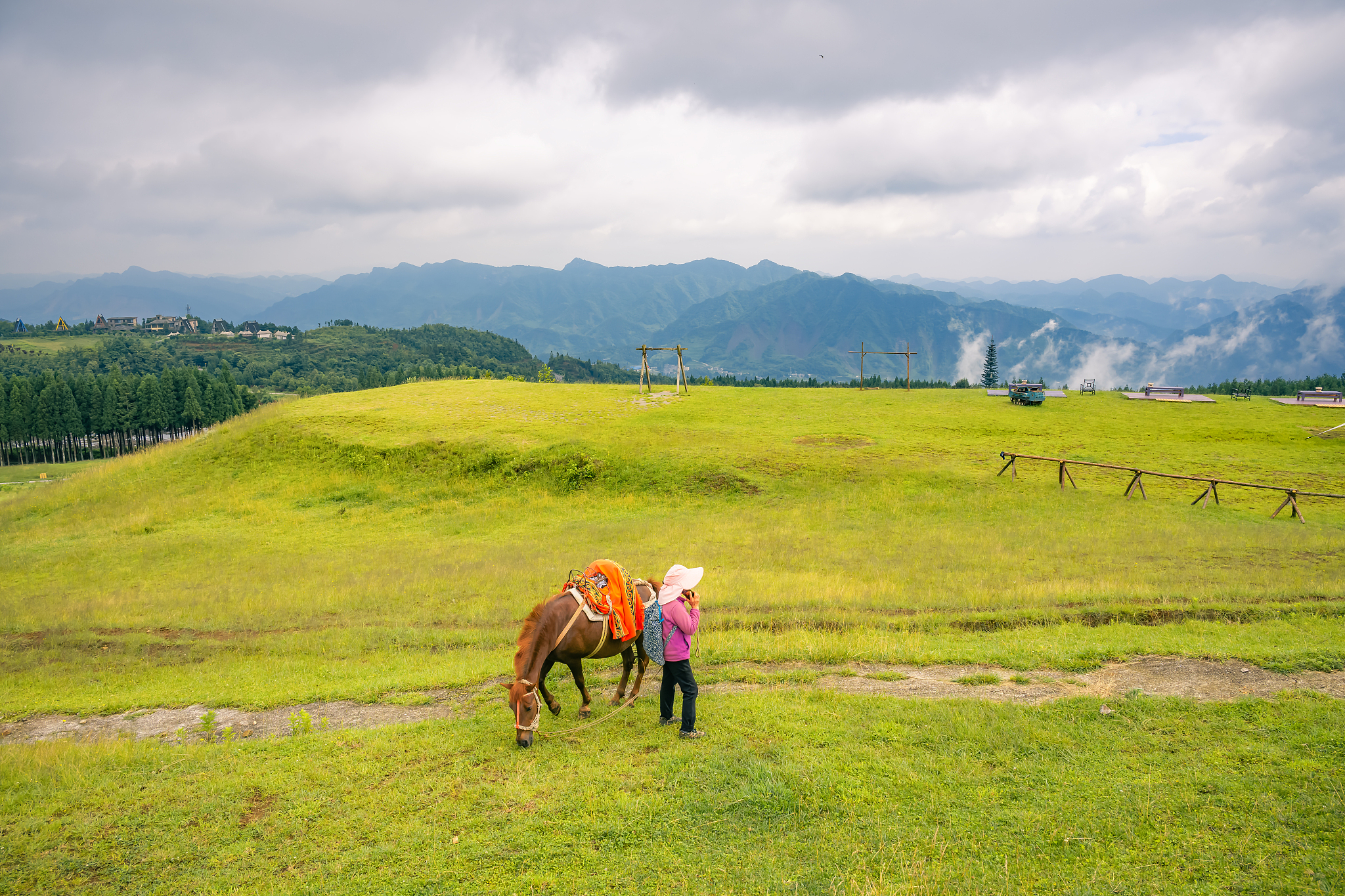
Yushe National Forest Park, located in the southern part of Shuicheng County, Liupanshui, Guizhou Province, covers an area of 34 km² with a core area of 5.4 km². Situated 30 km from the city center, it belongs to the Wumeng Mountain range and lies in the upper reaches of the Pearl River system. The park features lush forests, crisscrossing ravines, and majestic landscapes, with a forest coverage rate of 81.3%. Its highest elevation reaches 2,503 m, while the lowest is 1,700 m, creating a relative height difference of 803 m. It currently holds the distinction of being the highest-altitude forest tourism attraction in Guizhou Province.The attraction boasts a pleasant climate, convenient transportation, and abundant resources. The average summer temperature is 19°C, with forest coverage reaching 81.3% and negative oxygen ions reaching 3,500 per cubic cm.The entire park is located in the central subtropical monsoon climate zone, characterized by a plateau monsoon climate with distinct wet and dry seasons, where rainfall and heat coincide. The annual average temperature is 13°C, with a frost-free period of 240 days and an average precipitation of 1,175mm, making it one of the rare temperate and humid areas in the province. The unique terrain and climatic conditions have endowed the park with abundant flora and fauna resources. It is home to over 1,500 rare wild animals and plants, including golden pheasants, silver pheasants, white foxes, musk deer, dove trees (Davidia involucrata), Chinese yew (Taxus chinensis), ten-toothed flowers, and Sikkim magnolias, as well as more than 700 types of wild medicinal herbs such as fleeceflower root, eucommia bark, and pseudo-ginseng. Among these, the dove tree is a key protected plant. Its white flowers resemble flying doves, earning it the nickname “dove flower.” It is a relic plant from the Tertiary period of the Cenozoic era 10 million years ago, coexisting with dinosaurs and hailed as a “living fossil in the plant kingdom.” The Chinese yew, on the other hand, is globally recognized as a rare and endangered natural anti-cancer plant. With a lifespan exceeding 5,000 years, it is often called the “giant panda of plants” and praised as the “golden tree” or “longevity tree.” Every part of the Chinese yew is valuable—it purifies the air, with two 8-year-old yew trees releasing oxygen equivalent to 1,000 holly trees or a 600m² forest. Due to its unique geographical and climatic conditions, our city is also one of China’s earliest native habitats for Chinese yew and serves as a vital natural distribution zone and ideal growth environment. Currently, 118,000 wild Chinese yew trees have been discovered here, including 740 fruiting specimens. In June 2013, the China Wild Plant Conservation Association officially designated Liupanshui as the “Hometown of Chinese Yew.”Strolling through the woods, you’ll experience the transcendence of “walking until the stream ends, sitting to watch clouds rise,” as well as the serenity of “picking chrysanthemums by the eastern hedge, gazing leisurely at southern mountains.” On a winter morning, you might delight in the sudden wonder of “overnight spring winds bringing thousands of pear blossoms,” or reflect on the profound melancholy of “contemplating heaven and earth’s vastness, shedding solitary tears.” Marvel at the winter plum’s indomitable spirit, “blooming defiantly with frost underfoot, shining against snow in bitter cold.” At China’s southernmost ski resorts, enjoy carving through “sea of trees” powder, feel the adrenaline of live-ammunition shooting ranges, or unwind completely in misty hot spring baths at ryokan-style retreats.The park features the ancient Tea-Horse Road and Wumeng Pavilion with its wooden tower courtyard layout, where meandering streams and pearl-like waterfalls create a landscape as gentle as jade and elegant as a breeze. Here you’ll find Yueshe Snow Mountain Ski Resort, the first high-altitude and year-round ski destination in Guizhou Province with the lowest latitude in China. Complemented by dry slopes and seasonal flowers, it has become the premier skiing destination in Southwest China.With lush forests, verdant mountains, pristine waters, majestic trees, unique rock formations, dramatic gorges, and rich cultural heritage, Yushe Forest Park is perfect for ecological research, nature retreats, wellness activities, alpine skiing, and herbal baths. Its ever-changing seasonal landscapes make it an ideal destination for summer escapes, vacations, and leisure getaways.Currently, Yushu National Forest Park has developed several attractions, including the Yushu Snow Mountain Ski Resort, grass skiing field, live ammunition shooting range, and Snow Mountain Hotel. The resort adheres to the principles of “harmony between humans and nature” and “balanced economic development with ecological conservation.” By integrating healthcare concepts and Yi ethnic medicine, it has established a wellness center. The forest park has evolved into a comprehensive tourism destination offering dining, entertainment, leisure, vacationing, wellness, and sightseeing.The attraction boasts convenient transportation, with the Hangrui Expressway passing through the area and the Liangshui Line and Shuibai Railway located at the foot of the park. The park features approx. 25km of roads forming a figure-eight loop, with three entrances: the South Gate, North Gate, and East Gate.
Yushe Forest Park
作者:
在