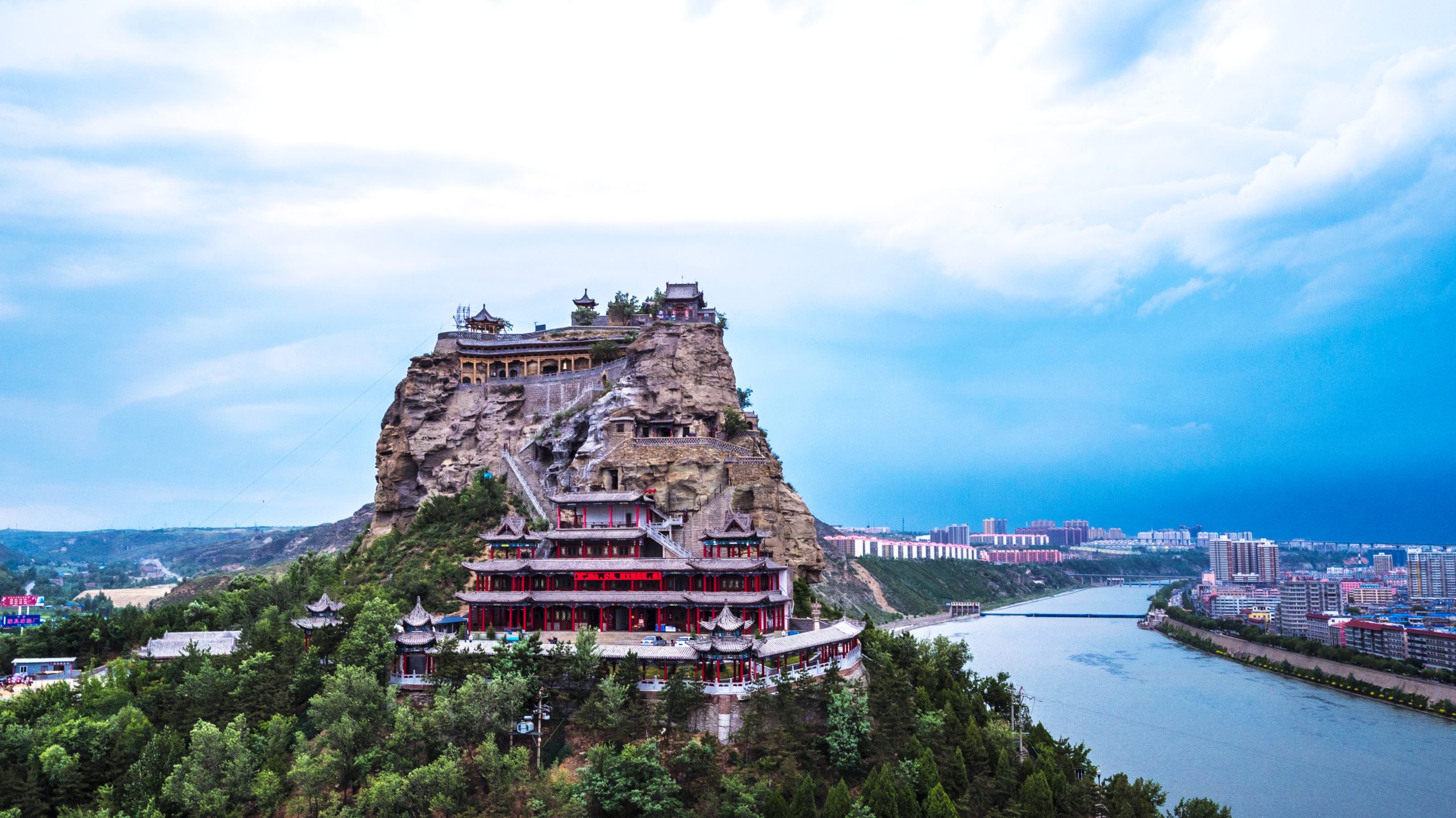
Shenmu Erlang Mountain is located 1 km west of Shenmu city along the Kuye River. It is now a national 4A-level tourist attraction and a provincial-level key cultural relic protection site. The mountain features two prominent ridges in its midsection resembling camel humps, earning it the poetic name “Camel Hump Mountain” among literati.In 1518, Emperor Wuzong of the Ming Dynasty, Zhu Houzhao, passed through this area during his imperial tour.Upon noticing the mountain’s resemblance to his desktop pen holder, he bestowed it the name Bijia Mountain, locally known as Xishan. The mountain features sheer cliffs on both sides, lush greenery in spring and summer, and a majestic yet desolate appearance in fall and winter. The winding Kuye River at its base accentuates its grandeur, earning it the reputation as “Little Huashan Mountain in Northern Shaanxi.” The attraction features numerous temples, including the Dizang Cave Grottoes, Erlang Mountain Scenic Area – Eight Immortals Cave, Haoran Pavilion Grottoes, and Erlang Mountain Scenic Area – Erlang Mountain Temple.Our Lady HallNumerous temples, including the Reversed Seat Guanyin Hall, Erlang Mountain Scenic Area – Three Religions Hall, and the Mountain God Temple, are built along the mountain slopes, each showcasing unique architectural styles. The Erlang Temple complex was built in 1443 during the Ming Dynasty, boasting nearly 600 years of history. This south-facing courtyard-style compound features a main hall, side chambers, east and west wing halls, a main gate, and bell and drum towers. The three-beam main hall with front corridor has a gable roof, adorned with traditional gongbi paintings from 1835 titled “Anecdotes of Yi Yun” on its eastern and western walls, plus 14 small landscape paintings on the rear wall. Outside the main gate stands a Ming-era brick screen wall with exquisite bas-relief carvings – a roaring tiger scene on the front and nine dragons playing in water on the reverse, all rendered with remarkable vitality. Built on a natural rocky platformOur Lady HallBuilt during the Qing Dynasty, the stone archway in front of the hall was constructed in 1628 (the first year of the Chongzhen era in the Ming Dynasty). It features stone-carved brackets under the eaves and a frieze with a relief of two dragons playing with a pearl. The front inscription reads “Bixia Temporary Palace,” while the northern side is carved with “Holy Mother Yuanjun.” Behind the hall lies the Ming Dynasty structure of the Erlang Mountain scenic area – the Hall of Various Deities. The Reversed-Seated Guanyin Hall was originally built during the Ming Dynasty but was later destroyed in war. It was restored in the 16th year of the Kangxi reign (1677). The Three Religions Hall in Erlang Mountain scenic area was first constructed during the Jiajing era of the Ming Dynasty (1522–1566) and rebuilt in 1935 as part of the Erlang Mountain attraction. Located midway along the mountain ridge, it forms one of the largest temple complexes on the mountain, featuring Ming-era colored murals on both eastern and western walls – the “Panoramic View of East Mountain” on the east wall and “Panoramic View of West Mountain” on the west wall. The Mountain God Temple, also dating back to the Ming Dynasty, is situated behind the ridge.
Erlang Mountain
作者:
在