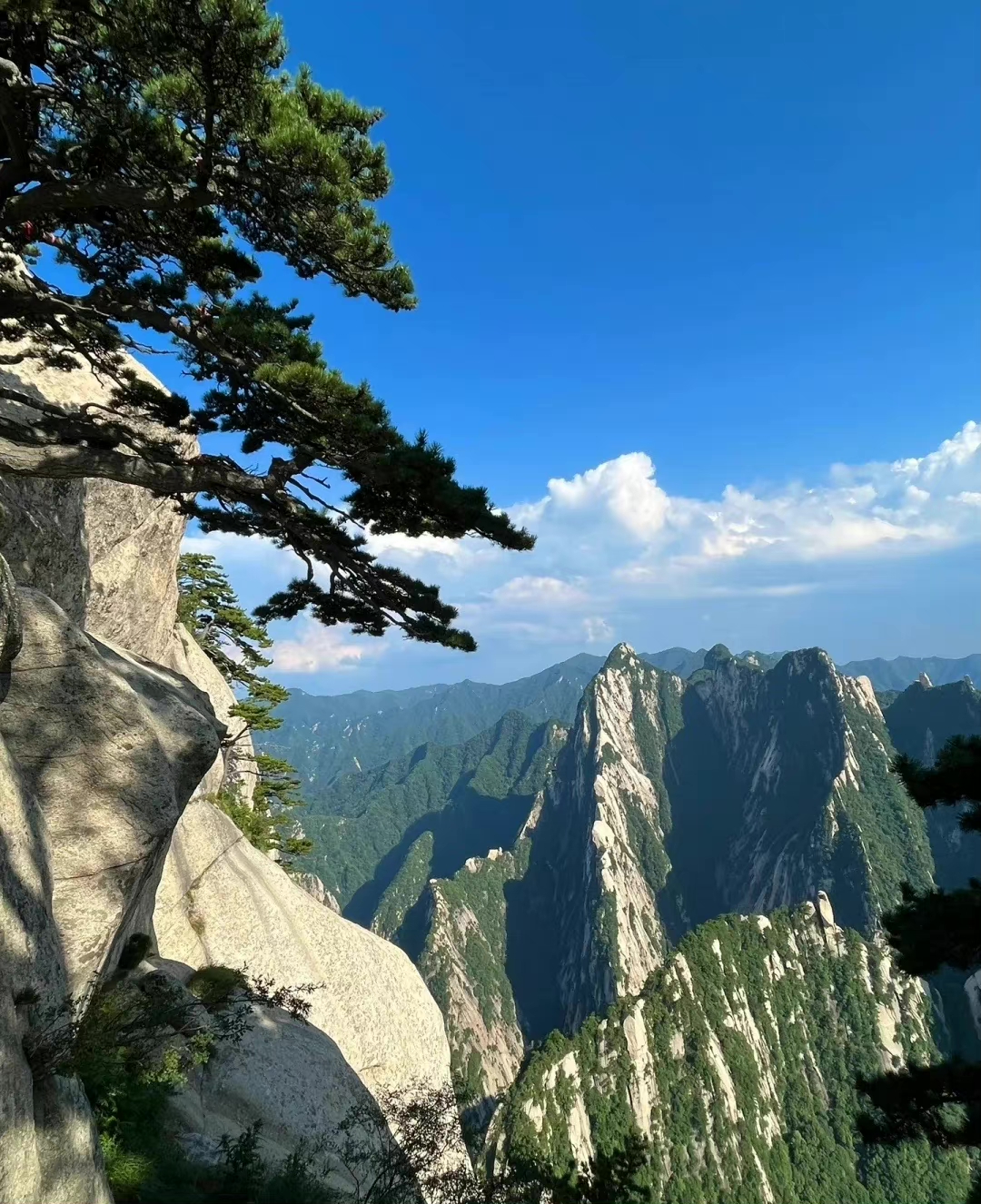
The South Peak of Mount Hua, at an altitude of 2160.8 meters, is the highest peak of Mount Hua. The South Peak has two summits: the eastern summit, Songhui Peak, is named for the many pine and cypress trees that grow there; the western summit, Luoyan Peak, is the highest point of the South Peak. Legend has it that because the mountain is so high, even wild geese cannot fly over it and must rest here, hence the name. Climbing to the top of the South Peak, one can see all the surrounding mountains below, overlooking the Loess Plateau, the Wei River Plain, and the Yellow River, Jing River, and Wei River all within view, filling one with a sense of grandeur and allowing one to truly appreciate the majestic and imposing grandeur of Mount Hua, enjoying the magical feeling of being in the heavens and walking on clouds. At the summit of the South Peak is Laozi Cave, where, according to legend, Laozi, the founder of Taoism, lived in seclusion. On a rock high at the summit of the South Peak are the two large characters “Zhen Yuan” (True Source). In addition, the South Peak also features Laozi Peak, the Alchemy Furnace, and the Bagua Pool, all of which are related to the legends of Laozi. North of Laojun Cave is Taishang Spring, flowing eastward down a stream, now called “Yangtian Pool,” its water a vibrant green year-round. At the foot of the cliff to its east is the “South Heavenly Gate” stone archway. On the South Peak of Mount Hua also stands the Jintian Palace, built during the Ming Dynasty, also known as the White Emperor Temple, dedicated to Shaohao, the god of Mount Hua.
Mount Hua South Peak
作者:
在