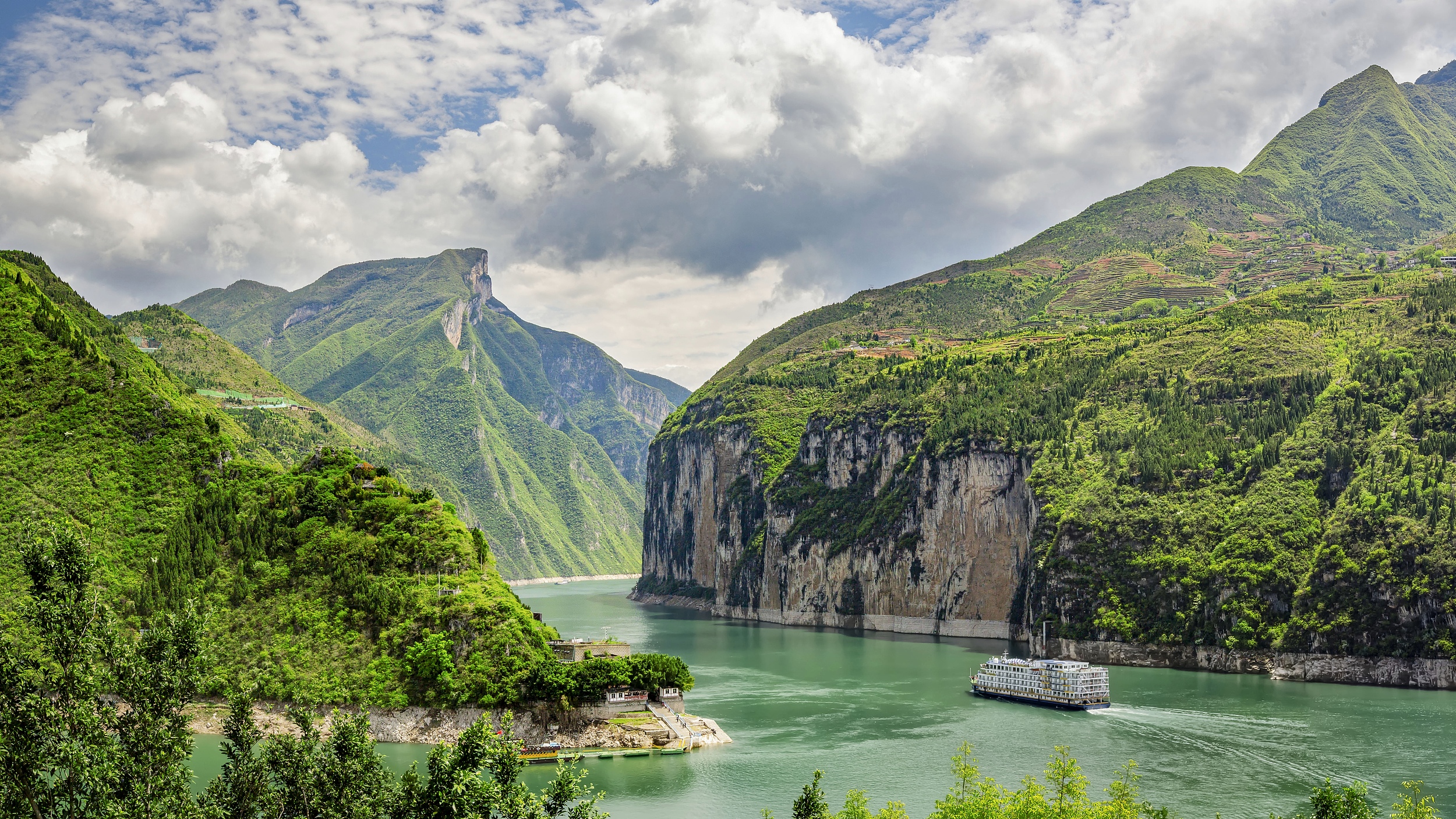
The Baidicheng (White Emperor City) and Qutang Gorge attraction is located on Baidi Mountain along the northern bank of the Yangtze River at the entrance to Qutang Gorge in Fengjie County, Chongqing. Situated at the western gateway to the Three Gorges of the Yangtze River, it faces Kuimen to the east, Baiyan Mountain across the river to the south, connects to Fengjie County town to the west, and backs against Jigong Mountain to the north, approximately 10 km east of Fengjie County town. Covering an area of 6 km², the attraction primarily consists of two major sections: Baidicheng and Qutang Gorge, featuring numerous historical sites that blend natural scenery with cultural heritage, poetic charm with wartime history. It serves as the starting point to experience the majestic beauty of the Yangtze Three Gorges. In 1978, Baidicheng became one of China’s first officially opened tourist attractions.Originally named Ziyang City, Baidi City was fortified by Gongsun Shu during the late Western Han Dynasty. In 25 AD, he proclaimed himself the White Emperor and renamed the city Baidi City. In 36 AD, the Baidi Temple was constructed on Baidi Mountain to honor Gongsun Shu. During the Ming Dynasty in 1533, the temple began enshrining Liu Bei and Zhuge Liang instead. Throughout the Tang and Song Dynasties, renowned poets like Li Bai, Du Fu, Bai Juyi, and Liu Yuxi visited, resided, or served as officials here, leaving behind timeless poetic works, earning it the reputation as the “City of Poetry.” After the Three Gorges Dam project raised water levels to 175m, Baidi City became an island surrounded by water, now a verdant oasis amidst the “calm lake within towering gorges.”Qutang Gorge, adjacent to Baidi City, spans 8 km and combines grandeur, wonder, danger, and steepness, making it the shortest, narrowest, and most perilous section of the Three Gorges. On the northern bank within Qutang Gorge, the Chijia Mountain features three major cultural sites—Laoguanmiao, Daxi, and Wushan Ape Man—along with attractions like the Laoguanmiao signal tower, Chijia Tower, ancient cannon emplacements, cliffside plank paths, and hanging coffins in Fengxiang Gorge. The southern bank’s Baiyan Mountain showcases remnants of the Mengliang Ladder ancient plank path, cliff carvings, Rhinoceros Gazing at the Moon Peak, and Ape Man Peak, encapsulating two million years of China’s human development history.The “Kuimen” at Qutang Gorge, also known as Qutang Pass, is a breathtaking natural wonder hailed as “the most majestic gateway under heaven.” Located at the western entrance of Qutang Gorge, it historically guarded the passage between Sichuan to the west and Hubei to the east, making it a strategic military stronghold throughout Chinese history. Towering cliffs stand like sentinels on both banks—sheer precipices carved by nature’s chisel, plunging vertically into the roaring Yangtze River where the legendary Yanyu Rock once stood as a navigational landmark. Here, the gorge narrows to a celestial slit, the river squeezes through nature’s grand gateway, and the valley clasps the mighty waterway in its grip—this is Kuimen. Renowned for its awe-inspiring grandeur, Kuimen earned ancient praise as “the world’s most heroic pass” and modern acclaim as “China’s iconic mountain-and-water gateway.” Its majestic profile graces the background of the 10-yuan note in China’s fifth series of renminbi currency.
Qutang Gorge
作者:
在