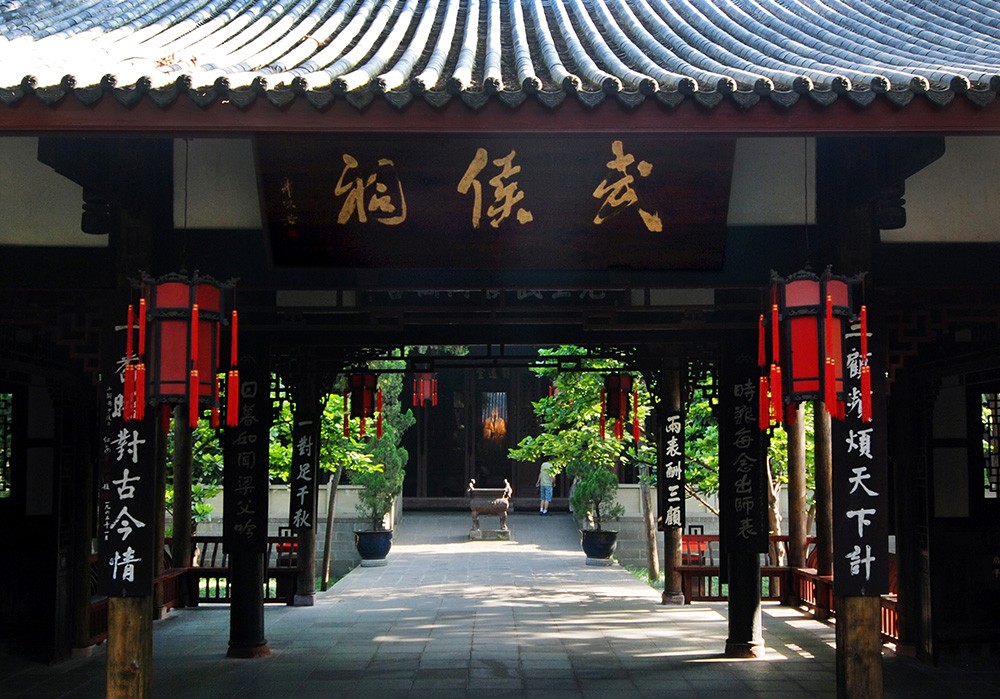
The Chengdu Wuhou Shrine Museum is a temple dedicated to honoring Shu Han heroes such as Liu Bei and Zhuge Liang. Its origins date back to 221 AD during the first year of the Zhangwu era under Emperor Zhaolie of Shu Han, when Liu Bei’s Hui Ling Mausoleum was constructed. The Han Zhaolie Temple was also built during the same period.Approx. around 500 AD during the Northern and Southern Dynasties period, the Wuhou Shrine was relocated from Chengdu’s “Shaocheng” to the vicinity of Hui Ling Mausoleum and Han Zhaolie Temple, maintaining this layout until the Ming Dynasty. In 1390 during the 23rd year of the Hongwu era, Zhu Chun, the Ming Prince of Shu, visited the Chengdu Wuhou Shrine Museum for worship. Citing that “monarch and subject should be united as one,” he merged Hui Ling Mausoleum, Han Zhaolie Temple, and Wuhou Shrine into a single complex. As Zhuge Liang’s influence among the common people surpassed that of Liu Bei, the site became colloquially known as “Wuhou Shrine.”The cultural relics area of the Chengdu Wuhou Shrine Museum mainly consists of the Hui Ling Mausoleum, Han Zhaolie Temple, Wuhou Shrine, and the Chengdu Wuhou Shrine Museum – Sanyi Temple, with the main structure being the Wuhou Shrine. The shrine is divided into the main gate, second gate, Liu Bei Hall, passage hall, Chengdu Wuhou Shrine Museum – Zhuge Liang Hall, and Chengdu Wuhou Shrine Museum – Sanyi Temple, all aligned along a central axis from south to north. The shrine houses 50 statues of Shu Han heroes including Liu Bei and Zhuge Liang, along with numerous stone inscriptions and plaques related to Zhuge Liang and Three Kingdoms culture.The famous “red wall and bamboo shadows” of Chengdu are located within the attraction. Don’t forget to take photos.The garden area of Chengdu Wuhou Shrine Museum, located on the west side of the shrine, features architectural structures such as the stone archway gate, three-arched gate, square pavilion, Jiexin Hall, and burial chamber. It is the only northern-style mausoleum complex in southwest China. The shrine is adjacent to Jinli Ancient Street (Jinli Folk Custom Area), making it convenient to visit both sites together.
Chengdu Wuhou Shrine Museum
作者:
在