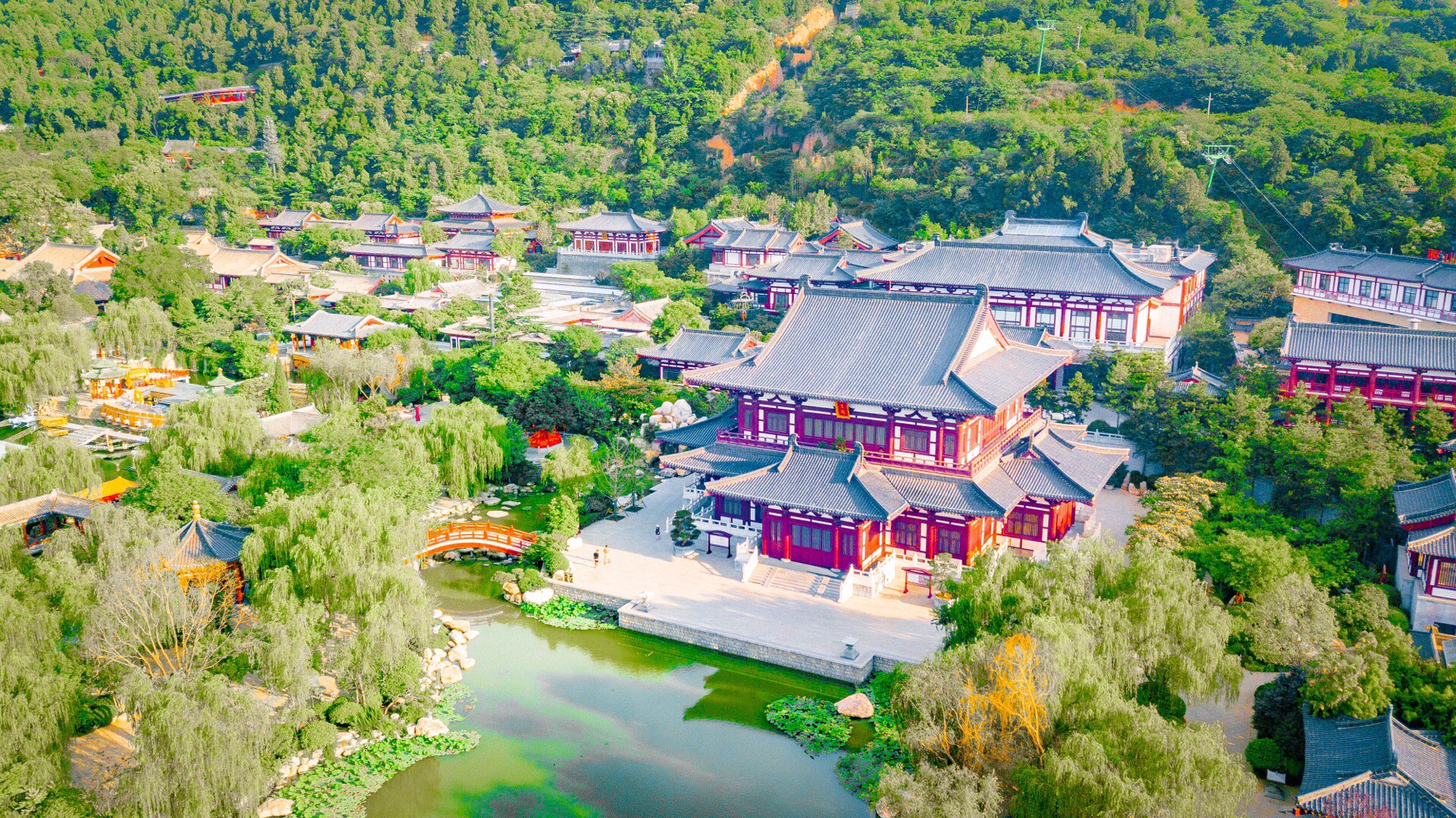
Huaqing Palace attraction is located 30 km east of Xi’an, adjacent to the Terracotta Warriors. Renowned for its timeless hot spring resources and numerous historical events, it has become an iconic cultural tourism attraction of Tang Dynasty palaces in China.Palace scenic spotsHuaqing Palace boasts a long history, serving as an imperial retreat for emperors from the Zhou, Qin, Han, Sui, and Tang dynasties. The palace features cultural zones like the Tang Imperial Hot Spring Relics Museum, the Xi’an Incident site—Five-Room Hall, Nine Dragon Lake and Lotus Lake scenic areas, and the Tang Pear Garden Museum. Notable architectural complexes include Feishuang Hall, Wanshou Hall, Changsheng Hall, Huanyuan Garden, and Yuwang Hall.The stele of “hot spring ode”Mount Li hot springs, developed early and favored by emperors throughout history, enjoy the reputation of being “the imperial hot springs under heaven.” As far back as the Yangshao culture period 6,000 years ago, the ancient Jiangzhai people began utilizing these springs. With their profound cultural heritage spanning millennia, Mount Li hot springs represent an indispensable part of Chinese historical culture.The stele of hot spring ode in the attraction stands 154 cm tall, 72 cm wide, and 19 cm thick, featuring a coiled dragon design and a trapezoidal base. Engraved by Yuan Chang, the governor of Yongzhou during the Northern Wei Dynasty, the inscription reads, “The hot spring is nature’s prescription and the primordial healer of the universe. People from all nations and those suffering from ailments come with provisions to seek relief in its waters.” This stele is the earliest surviving written artifact at Huaqing Palace.Tang Imperial Hot Spring Relics MuseumThis is the site of the bathing pool described in the “Song of Everlasting Sorrow” where Yang Guifei emerged from her bath. After the An Lushan Rebellion, little remained of the original structure. In 1982, while constructing the “Guifei Pavilion,” the Lintong County Government accidentally discovered the ruins of a Tang Dynasty bathing pool. After excavation and restoration, the Huaqing Palace imperial hot spring ruins museum was established. This small yet exquisitely designed pool measures 3.6 meters east-west and 2.9 meters north-south, with an oval-like shape. The pool walls are entirely built with bluestone slabs, featuring a two-tiered terrace structure composed of 18 arched stone sections. Inside the pool lies a dedicated bathing stone for Yang Guifei, engraved with the character “Yang.” At the center of the pool bottom is a 10 cm diameter water inlet. A white marble lotus pedestal was unearthed here, connecting to both a showerhead above and ceramic water pipes below that linked to the main water source. Due to natural pressure, hot spring water would spray outward through the lotus showerhead, creating a mist effect remarkably similar to modern showers. Adjacent to the Guifei Pool to the east lies Emperor Xuanzong’s exclusive imperial hot spring. During the Tang Dynasty, the Nine Dragon Hall stood above this pool, featuring nine white jade-carved dragons spouting water outside. This pool’s surface resembles a realistic lotus shape, hence its alternate name “Lotus Pool.”Xi’an incident siteThe five-room hall at the Xi’an incident site in Huaqing Palace is where the Xi’an incident took place. To this day, the glass windows and walls of the five-room hall still bear bullet marks from the fierce battle during the military remonstrance. The desks, chairs, beds, sofas, tea sets, stoves, carpets, telephones, and other office items in each room are replicated and arranged according to their original appearance.Historical events:Beacon fire to deceive the feudal lordsIn 779 BC, King You of Zhou obtained the beautiful Bao Si, yet she never smiled. To solve this, the king conspired with the treacherous minister Guo Shifu and lit the beacon fires at the Huaqing Palace attraction. The feudal lords across the land saw the signals.Beacon fireHe quickly led his troops to rescue the king, but King You told the feudal lords, “I lit the beacon fires just to make my queen laugh,” upon which Bao Si burst into laughter. The feudal lords arrived valiantly but left resentfully. Seeing King You’s incompetence and the people’s discontent, the Quanrong tribe seized the opportunity to launch an attack. As the enemy troops approached the mountain, King You urgently raised the beacon fires.Beacon fireHe mobilized troops, but none of the feudal lords came to his rescue. King You fled with Bao Si toMount LiHe was later killed by the Quanrong tribe, leaving behind historical anecdotes such as “a smile worth a thousand gold,” “losing the kingdom for a smile,” and “playing with beacon fires to deceive the feudal lords.”And this beacon tower at Huaqing Palace attraction towers at an altitude of 913.6 m.Mount LiThe beacon tower at Huaqing Palace attraction on the first peak of Xixiu Ridge.Su Dongpo composing poetry at Mount LiDuring the Jiayou era of the Northern Song Dynasty, the Lishan hot springs, meticulously restored by Liu Ziyong and others, became breathtakingly beautiful, attracting crowds of visitors who composed poems and essays to express their nostalgia. Among the countless poetic works, the emerging literary giant Su Shi stood out with his masterpieces like “Lady of Guo’s night outing” and “Lishan” during his visit to the hot springs.Xi’an incidentThe Xi’an incident, also known as the “double-twelfth incident”. Zhang Xueliang and Yang Hucheng launched a mutiny at Huaqing Palace, detaining the then chairman of the Military Commission of the National Government.Performance itemsYou can watch a large-scale dance drama at the attraction.▲ The Song of Everlasting Sorrow is China’s first large-scale live historical dance drama created by Shaanxi Tourism Group. Based on Bai Juyi’s timeless poem of the same name, it fully utilizes the attraction’s resources and employs high-tech stage lighting to combine historical storytelling with live performances, recreating the love story of Emperor Li Longji and Yang Guifei at Huaqing Palace over 1,300 years ago.▲There is also the historical adaptation “12-12 Xi’an Incident,” which vividly and authentically recreates the lesser-known details of the “Xi’an Incident.”
Huaqing Palace
作者:
在