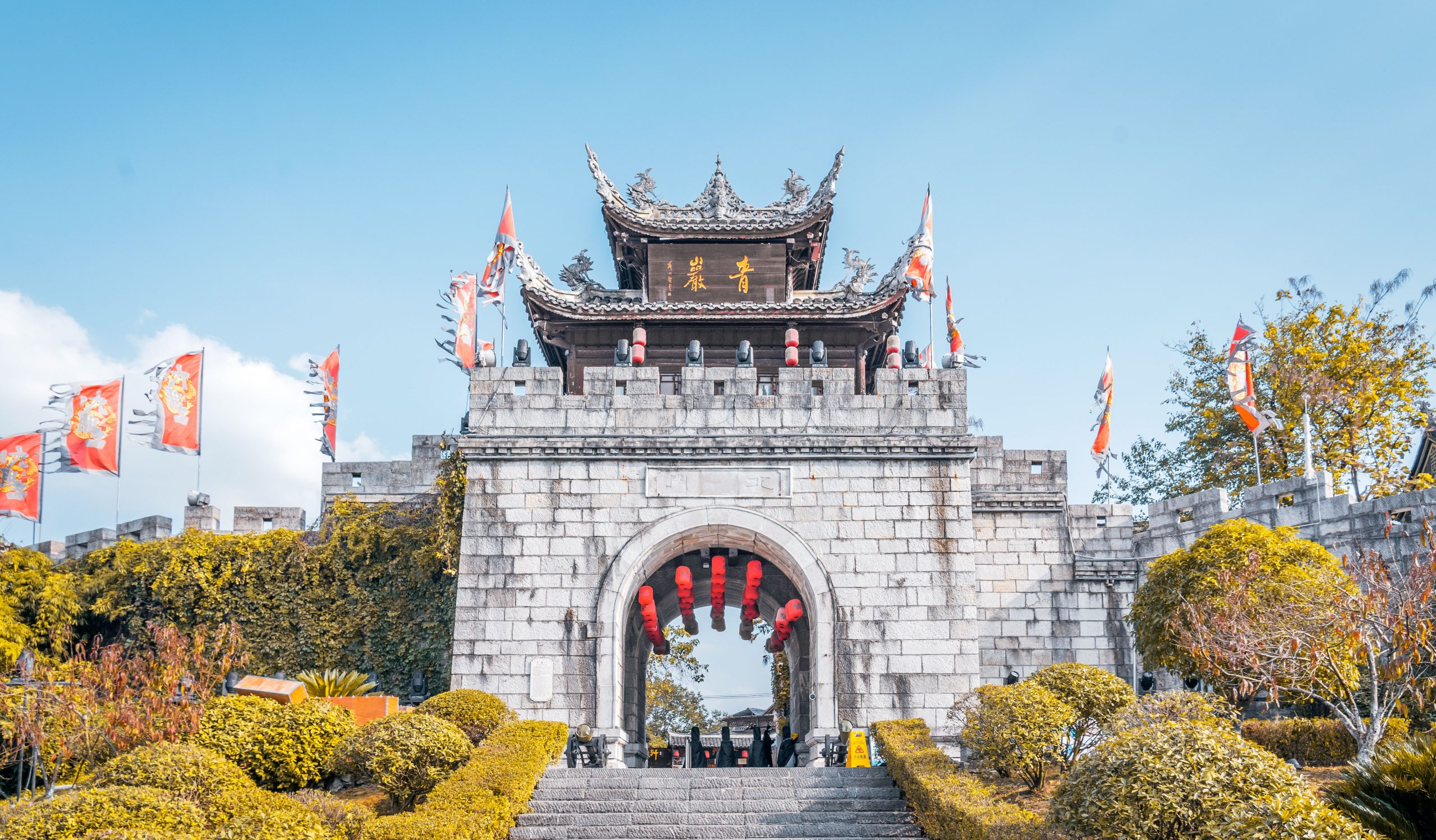
Qingyan Ancient Town is located in Huaxi District, the southern suburb of Guiyang, and is known as one of Guizhou’s four ancient towns alongside Zhenyuan, Bing’an, and Longli. Established during the Ming Dynasty as a military stronghold, the town preserves numerous well-maintained ancient buildings from the Ming and Qing periods. The filming of the movie “The Missing Gun” brought Qingyan Ancient Town to wider recognition.The ancient town’s architecture follows the natural mountain contours, with its city walls built from massive stones on cliffs. It features four city gates at the east, west, south, and north. The exquisite stone and wood carvings in the town’s buildings are a major highlight.The south gate of the ancient town, Dingguang gate, is the most magnificent among the four main gates. Historically, it served as the first gateway guarding the southern entrance to Guiyang. The towering gate tower and city walls built with massive stones, along with the winding flagstone path outside the town and surrounding farmland, create a spectacular landscape. Many promotional photos of Qingyan ancient town are taken here.Entering the ancient town through Dingguang gate, the first sight is the Zhaolilun centenarian memorial archway. Built by imperial decree during Emperor Daoguang’s reign in the Qing dynasty, this archway features an unusual design – the stone lions carved on its four pillars are upside down compared to conventional ones, creating a peculiar sight. Walking along the ancient stone-paved post road, you’ll find shops on both sides selling local specialties. Unique snacks like braised pig’s feet, grilled tofu, and rose candy offer distinctive flavors worth trying when you need a break from exploring.The ancient post road winding from the south gate to the north gate serves as both the central axis and main street of the ancient town. Divided by the ancient cultural square at the town center, the northern section is called North Street while the southern section is named South Street. Intersecting with the main street are East Street to the east and West Street to the west. Following East Street eastward leads to Wenchang Pavilion at No. 143, a brick-and-wood structure built during the Wanli era of the Ming Dynasty. This octagonal pavilion with multiple eaves was constructed against the mountain slope and served as a gathering place for scholars to study, socialize, and worship the Wenchang deity – visitors may also pay their respects if interested.Heading west along the main street, you’ll reach various distinctive religious buildings in Qingyan Ancient Town, including Yingxiang Temple, Ciyun Temple, Wanshou Palace, and the Catholic Church, all exquisitely crafted and perfect for photography. Between South Street and West Street lies a quiet alley called Back Street. This stone-paved lane is one of the most characteristic features of Qingyan Ancient Town, with its bluish-black flagstones polished smooth by centuries of use, reflecting light like mirrors to create a profound sense of tranquility. The narrow, serene path follows the mountain’s contours, flanked by layered slate walls, making it an ideal photography spot.The streets and alleys in Qingyan ancient town are deep and winding, but there are signposts on the main street and at every important intersection. Moreover, most lanes can loop back to the main street, so you don’t need to worry about getting lost while exploring the ancient town.
Qingyan Ancient Town
作者:
在