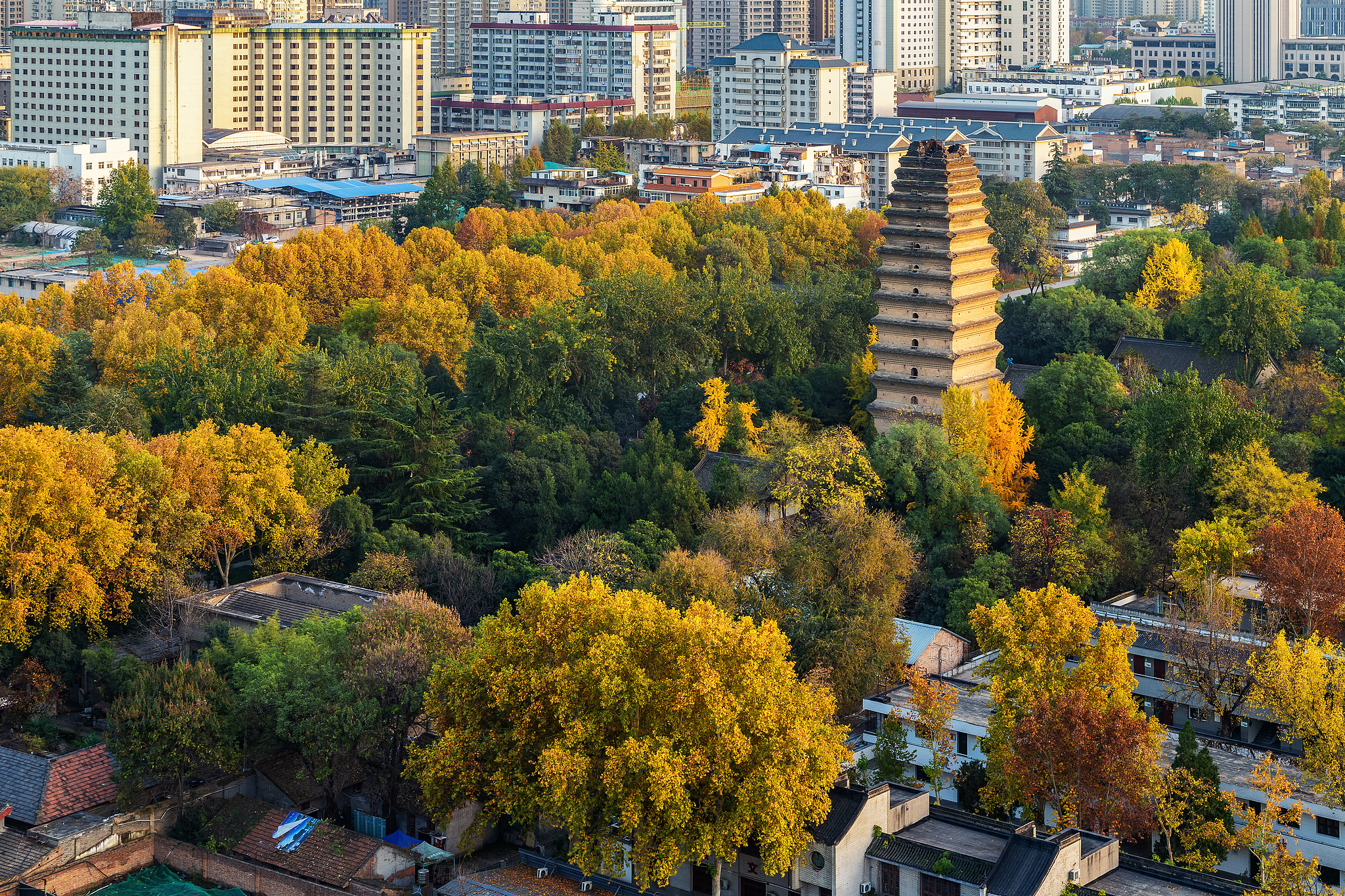
The site of Jianfu Temple within the Small Wild Goose Pagoda Heritage Park forms the core component and outdoor area of Xi’an Museum. It earned its name because its pagoda shape resembles the Giant Wild Goose Pagoda but is smaller. Compared to the bustle of the Giant Wild Goose Pagoda, this place offers much more tranquility. At the base of the pagoda, exquisite stone carvings from various dynasties are displayed outdoors, including Buddhist statues, stone lions, stone horses, and hitching posts—a must-see for visitors who appreciate folk artifacts. This multi-eaved brick pagoda originally had 15 stories but now stands with 13, reaching about 43.4 meters in height. With its elegant and slender silhouette and smooth contour lines, it is a classic example of Tang Dynasty square multi-eaved pagodas. As one of Xi’an’s important symbols of its ancient capital heritage, it holds the prestigious title of “Morning Bell at the Wild Goose Pagoda,” one of the “Eight Scenic Wonders of Guanzhong.” Jianfu Temple was originally built in 684 AD during the first year of Emperor Ruizong’s reign in the Tang Dynasty, initially dedicated to honoring Emperor Gaozong. Later, between 707–710 AD during Emperor Zhongzong’s reign, a pagoda was constructed within the temple to house Buddhist scriptures and statues brought back from India by the eminent monk Yijing.This is the tower named for its distinctive shape.Therefore, it is inseparable from the Jianfu Temple and serves as a physical witness to the temple’s former glory and a landmark structure. After enduring the vicissitudes of time, most of the Jianfu Temple’s halls and buildings no longer exist.But thisPrecious Tang Dynasty architectural relics have been preserved to this day.
Small Wild Goose Pagoda Heritage Park
作者:
在