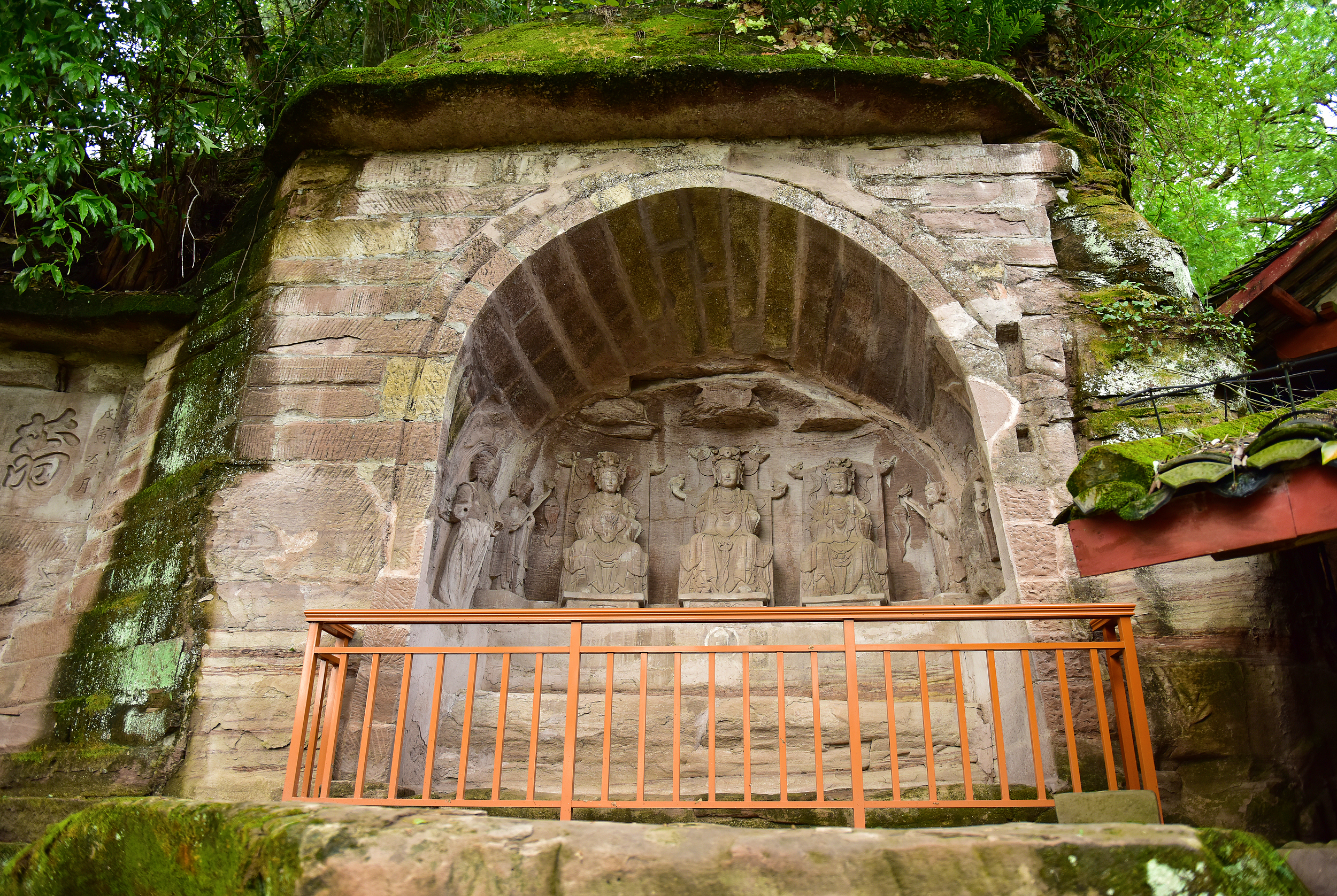
Nanshan Mountain, formerly known as Guanghua Mountain, is located 2 km south of Longgang Town in Dazu County, with an elevation of 514 meters. The carvings were created between 1131–1162 AD during the Southern Song Dynasty’s Shaoxing era. The cliff face spans 86 meters in length and ranges from 3.5–10.2 meters in height, divided into 15 numbered sections. Among them are 5 niches and caves featuring Taoist themes, including the Three Pure Ones Ancient Cave, Empress of Earth Niche, and Dragon Cave. Within the Dazu Rock Carvings, the 11th–13th century Taoist sculptures represent China’s most numerous, concentrated, and complete depiction of the Taoist pantheon. Five well-preserved sites remain, with Nanshan being the most prominent. For example, Cave No. 5 (Three Pure Ones Ancient Cave) contains 421 statues, primarily featuring the supreme Taoist deities “Three Pure Ones,” accompanied by the “Four Heavenly Ministers,” Holy Mother, Queen Mother of the West, and other deities. This vividly reflects the 12th-century evolution of Taoism from early worship of Laozi and the “Three Officials” to a clearly defined pantheon centered on the “Three Pure Ones” and “Four Heavenly Ministers.” Among China’s Song Dynasty Taoist grottoes, this cave boasts exceptionally refined craftsmanship. In terms of content, it provides the most comprehensive and systematic representation of Song Dynasty Taoist theology. The Three Pure Ones Ancient Cave holds immense religious, historical, and artistic value. Nanshan also preserves 28 stone inscriptions, including the 1250 AD He Guangzhen’s Farewell to Prince Meng Ying Stele. This records the sociopolitical conditions in eastern Sichuan following Mongol invasions during the mid-13th century, preserving valuable firsthand historical materials. These inscriptions serve crucial functions in “verifying history with steles,” “supplementing history with steles,” and “dating periods with steles.”
Stone Carvings of South Mountain
作者:
在