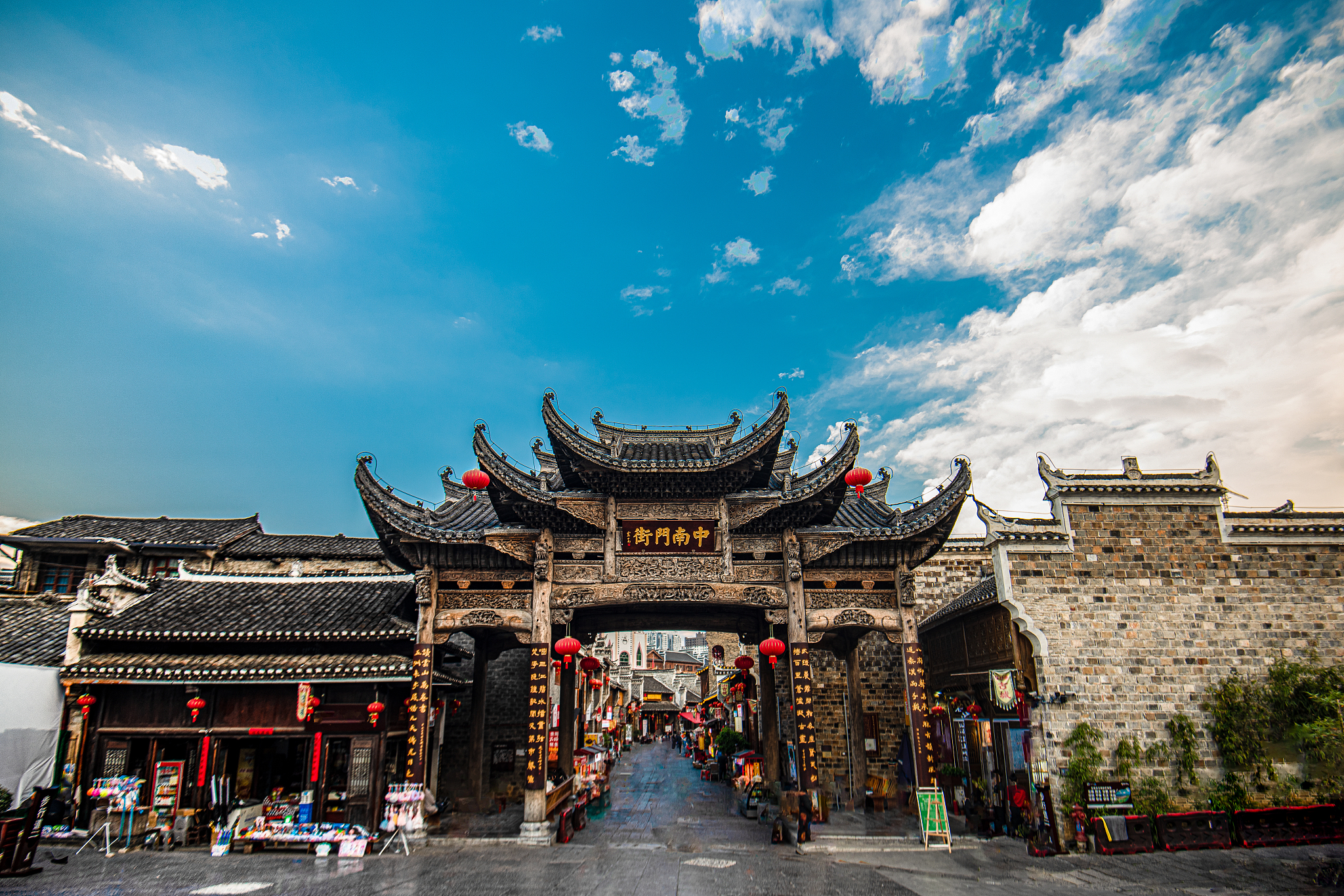
Tongren Ancient City is located in the heart of Tongren, surrounded by water on the east, south, and west sides, with only the north side backed by mountains. Its strategic terrain makes it easy to defend but difficult to attack. Covering a total area of 37,000 square meters, the ancient residential buildings span 26,000 square meters, representing Tongren’s original historical district that reflects the ancient city’s charm and its unique ethnic cultural resource. As a well-preserved ancient city, Tongren Ancient City not only showcases rich historical relics and traditional architecture but also offers visitors an ideal place to explore local culture and enjoy leisure time. According to historical records, Tongren Ancient City was born from the convergence of two rivers. During the Yuan Dynasty, fishermen discovered three bronze statues representing Confucianism, Buddhism, and Taoism at the confluence of the rivers outside the city, which gave Tongren its name. Recent archaeological findings reveal that as early as 3,000 years ago, the banks of the Jinjiang River in Tongren were already densely populated and culturally vibrant. By the Ming and Qing dynasties, the city had become a bustling hub of commerce, with boats shuttling back and forth and merchant guilds flourishing, earning it the title “Eastern Guizhou’s Commercial Hub.” Construction of the earthen city walls began in 1451 during the Ming Dynasty, following the river’s course. Over time, successive administrations reinforced the walls with stone, forming a layout of nine gates, three main streets, and six alleys. Remarkably well-preserved, Tongren Ancient City was designated a National Key Cultural Relics Protection Unit in 2006. The city retains its ancient streets, alleys, walls, water docks, wells, trees, and traditional courtyard houses, with rows of blue-brick buildings and black-tiled roofs standing as rare physical archives of urban development. Tongren Ancient City runs north-southZhongshan RoadThe main axis runs vertically, with buildings lining both sides of the road, interconnected by countless east-west alleys. Watchtowers, ancestral halls, residences, shops, lanes, city walls, and docks gradually unfold in sequence, boasting a large quantity and complete variety of structures. According to surveys, most buildings in Tongren Ancient City are 200–300 years old, where ethnic residential architecture, religious buildings, and commercial structures harmoniously blend. Here, the cultures of eastern Guizhou, central China, and Huizhou merchants converge, vividly reflecting the city’s historical development. With the opening of the “Taoyuan Tongren·Ming-Qing Ancient City” cultural tourism festival in Tongren Ancient City, the area now radiates fresh vitality, offering exceptional sightseeing and experiential value. Visitors can immerse themselves in Tongren’s local charm and cultural heritage while exploring its streets.
Tongren Ancient City
作者:
在