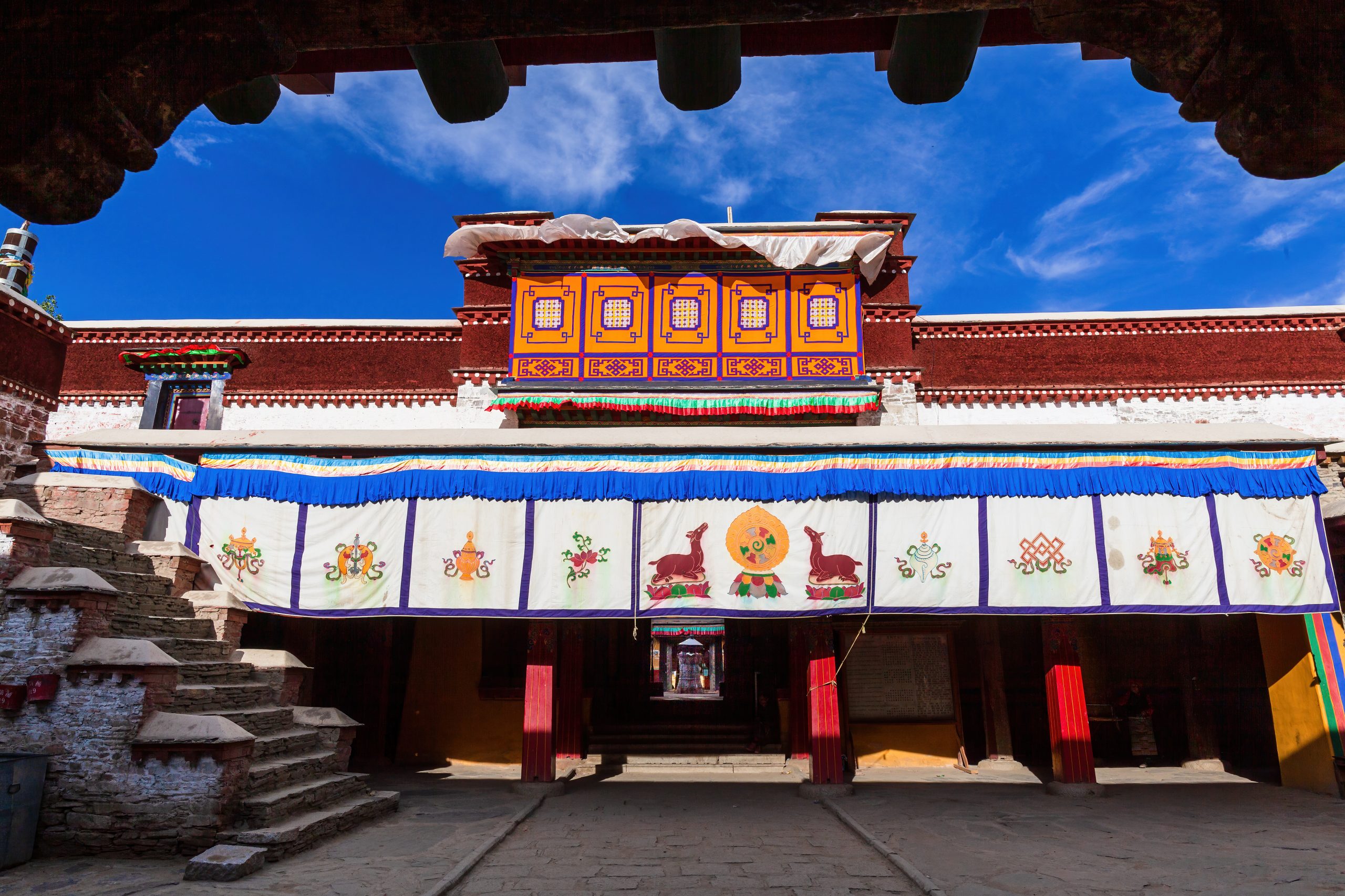
In Tibetan, “Chang” means eagle or hawk, and “Zhu” means dragon. Legend has it that before the temple was built, a vicious dragon lurked here, which was subdued by Songtsen Gampo in the form of a Garuda, thus allowing the temple to be built, hence the name. It is said that famous figures in Tibetan Buddhist history, such as Padmasambhava and Milarepa, practiced around Changzhu Temple, and the remaining ruins of their practice sites are sacred sites for Buddhist pilgrims. According to legend, the temple was built in the 7th century under the supervision of the Tibetan king Songtsen Gampo, and later renovated and expanded by Phagmodrupa Da Situ Juequ Jiancan. It is said that Princess Wencheng once stayed and practiced at the temple, leaving behind relics. During the Phagmodrupa regime, Changzhu Temple underwent large-scale repairs and expansions. In its later period, Changzhu Temple belonged to the Gelug school. The layout and form of the lower level of the main hall of Changzhu Temple are similar to the main hall of the Jokhang Temple in Lhasa. The temple originally preserved a large number of ancient murals and statues of Songtsen Gampo, Princess Wencheng, Princess Bhrikuti of Nepal, and Minister Gar Tongtsen, among others, all with simple and vivid styles. The pearl thangka of Changzhu Temple is its most prized possession, depicting the image of Gyaltsen Avalokiteshvara (a Bodhisattva at rest). The entire thangka is 2 meters long and 1.2 meters wide, using 26 taels of pearls (29,026 pieces in total), inlaid with one diamond, two rubies, one sapphire, 0.55 taels of amethyst, 0.91 taels of turquoise (185 pieces), 4.1 taels of coral (1,997 pieces), and 15.5 grams of gold. It attracts many believers and tourists to visit and worship daily.
Tradruk Temple
作者:
在