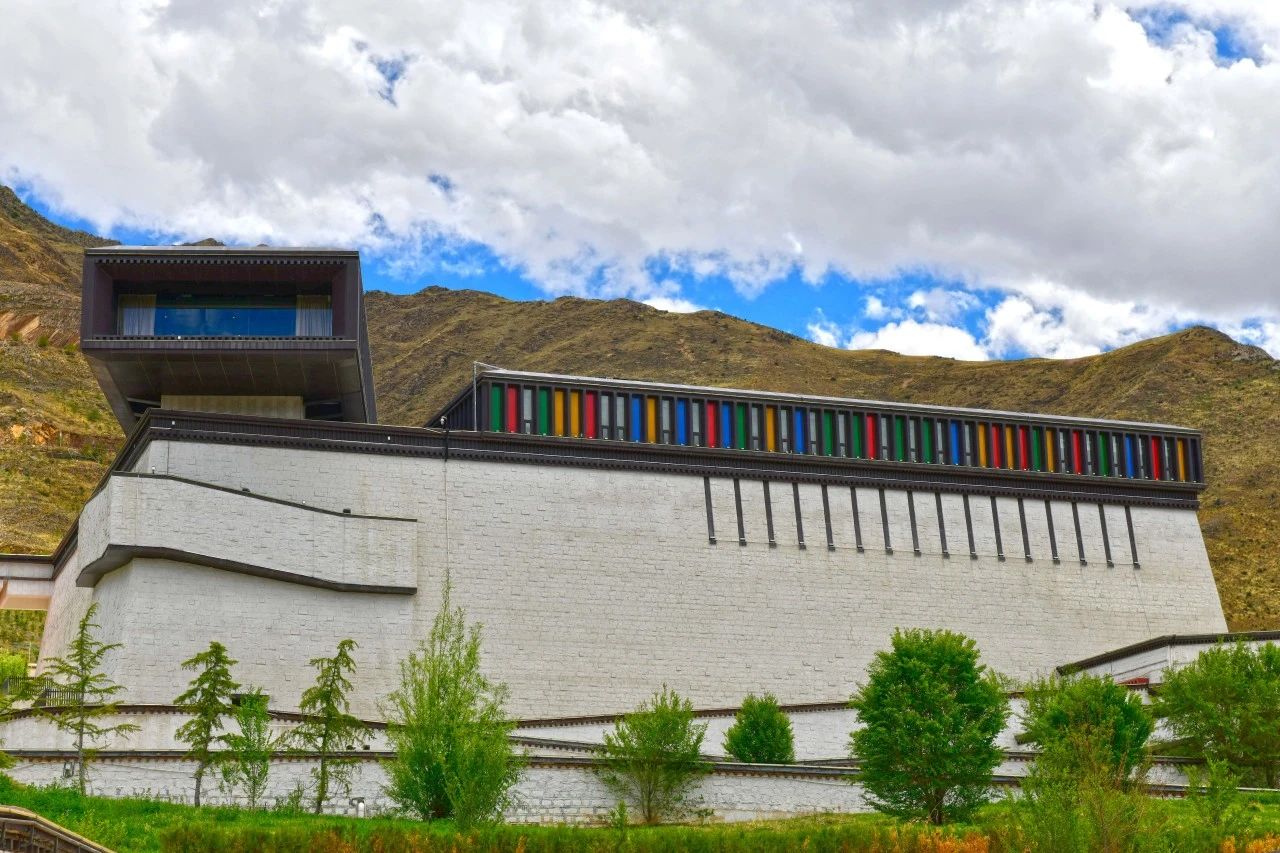
To fully promote and showcase the autonomous region’s intangible cultural heritage resources and conservation achievements, enhance public awareness of the importance of intangible cultural heritage protection, and foster a positive social environment where “everyone protects cultural heritage and shares in its conservation results,” this museum has become the region’s dedicated institution for preserving, inheriting, and disseminating intangible cultural heritage. It officially opened to the public with free admission starting May 1, 2024.The Intangible Cultural Heritage Museum and Qian Gong Fang project covers a total planned area of 40,000 square meters (60 mu), with the museum occupying 24,912.58 square meters of land and featuring a construction area of 7,999.35 square meters, while the Qian Gong Fang project spans 15,087.42 square meters of land with a built-up area of 4,943.96 square meters. Currently one of the world’s highest-altitude intangible cultural heritage museums, it serves as a key component of the local cultural tourism and creative district. Following the mountainous terrain, the museum features a zigzagging “Path to the Sky” ascent. Visitors wind upwards from the entrance to the main exhibition hall, navigating spiral corridors that offer unique spatial designs and scenic views at every level—creating a multi-layered experience of varying heights, lighting, and perspectives. The observation deck atop the building forms a dialogue across time and space with the Potala Palace opposite, overlooking the Lhasa River Valley.The museum features six themes—”Harmony in Beauty, Compassion in Sharing, Splendor in Wonder, Craftsmanship in Art, Joy in Delight, and Strength in Majesty”—spanning ten major intangible heritage categories and covering key intangible heritage items. It includes 3 UNESCO Intangible Cultural Heritage Masterpieces, 37 representative intangible cultural heritage projects, and 51 regional-level intangible cultural heritage projects. Additionally, 91 intangible heritage items suitable for static museum displays are showcased across 19 exhibition zones, featuring over 60 categories—such as Tibetan calendar calculations, Tibetan medicine, thangka, Tibetan paper, woodblock printing, textile techniques, traditional costumes, Tibetan incense, Tibetan opera, and yak-hide boats—with nearly 800 exhibits.The completion of the Intangible Cultural Heritage Museum not only promotes the publicity and promotion of intangible cultural heritage and the development of a thriving cultural tourism industry, but also serves as a vital cultural platform. It provides an important stage for preserving and promoting intangible cultural heritage, while becoming a new cultural tourism highlight that enhances the charm of Lhasa.
Xizang Fei Wuzhi Wenhua Yichan Museum
作者:
在